

The Business Challenge: Everyone Wants Your Attention
Think about the last time you walked into an arcade or family entertainment center. Everywhere you look, something is trying to get your attention. Screens are flashing, games are running demonstrations, animations are playing, and each machine is doing its best to convince you that it's the one worth spending your money on.
And that's part of the fun. You're there to be entertained, explore what's available, and decide what you want to play. Some games catch your attention immediately. Others you walk right past. And some you've seen so many times that you barely notice them anymore.
Now imagine bringing that environment into a grocery store, pharmacy, or big-box store.
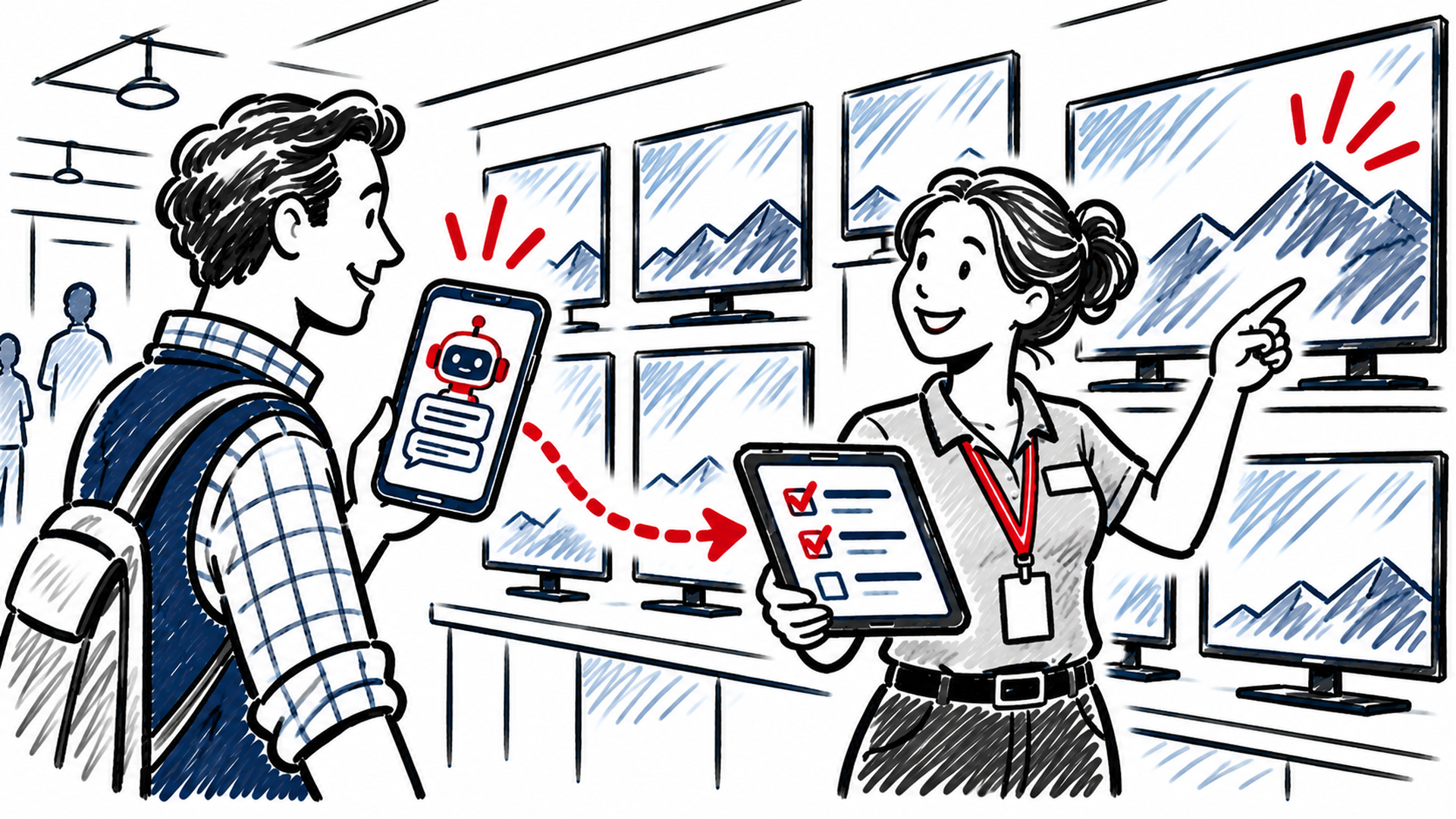
Digital shelf displays, connected cooler doors, interactive endcaps, and smart shopping carts create new opportunities to reach customers. Some help shoppers discover products, compare options, or find relevant offers. Others display advertisements from manufacturers paying for that space.
For retailers, there's a significant opportunity. Retail media creates another revenue stream, potentially helping fund connected stores and interactive experiences. But someone shopping for groceries after work probably has different expectations from someone visiting an arcade. Even within the same store, one person might stop for a demonstration while another just wants to get home.
Every retailer has also spent years developing an identity customers recognize. As manufacturers introduce more advertising, how does the retailer make sure that identity doesn't get lost?
At what point does retail media become part of what makes a store worth visiting, and when does it start getting in the way?
The Business Questions: What Are We Actually Trying to Create?
Retailers are moving beyond individual advertising placements. RaceTrac recently announced Trac Media Group, launching across more than 600 RaceTrac-branded locations, with plans to expand to RaceWay, Gulf, and Potbelly.
And why stop at traditional retail? Topgolf launched Topgolf Media Networks in July 2026, creating sponsorship opportunities across its venues and experiences. Restaurants already have relationships with beverage companies and ingredient suppliers. Could those partnerships help fund interactive experiences rather than just traditional promotions?
As we head into NRF ’27, there are four questions we want to investigate.
Does the business case hold up? Can in-store retail media generate meaningful profit after installation, content, maintenance, and operating expenses?
Can everything work together? Can retail media, connected commerce, and experiential retail support the environment a retailer wants without introducing another disconnected system?
Will manufacturers collaborate? Will they adapt content to individual retailers or insist on controlling their own campaigns?
And what about customer trust and operations? How much information is necessary, and who maintains the technology when something goes wrong?
A profitable advertising business isn't necessarily a successful investment if it damages the experience or creates expensive new operational responsibilities.
Are retailers building advertising networks inside their stores, or building better stores that advertisers help fund?
What's Changing: From Traditional Promotions to Connected Retail Media
Retailers and manufacturers have worked together on promotional placement for decades. We've all seen cardboard displays, branded endcaps, and elaborate Coca-Cola or Pepsi displays built around football season. There's an entire part of retail dedicated to coordinating promotions and negotiating space.
Advertising inside the store isn't new. What's changing is how connected those experiences can become. Instead of displaying the same message for weeks, retailers can potentially change content based on location, time of day, inventory, or even the weather.
Digital shelf displays, connected cooler doors, smart carts, and interactive fixtures create more opportunities to reach shoppers. One might promote a sponsored product while another provides ingredients, reviews, or demonstrations. Some could do both.
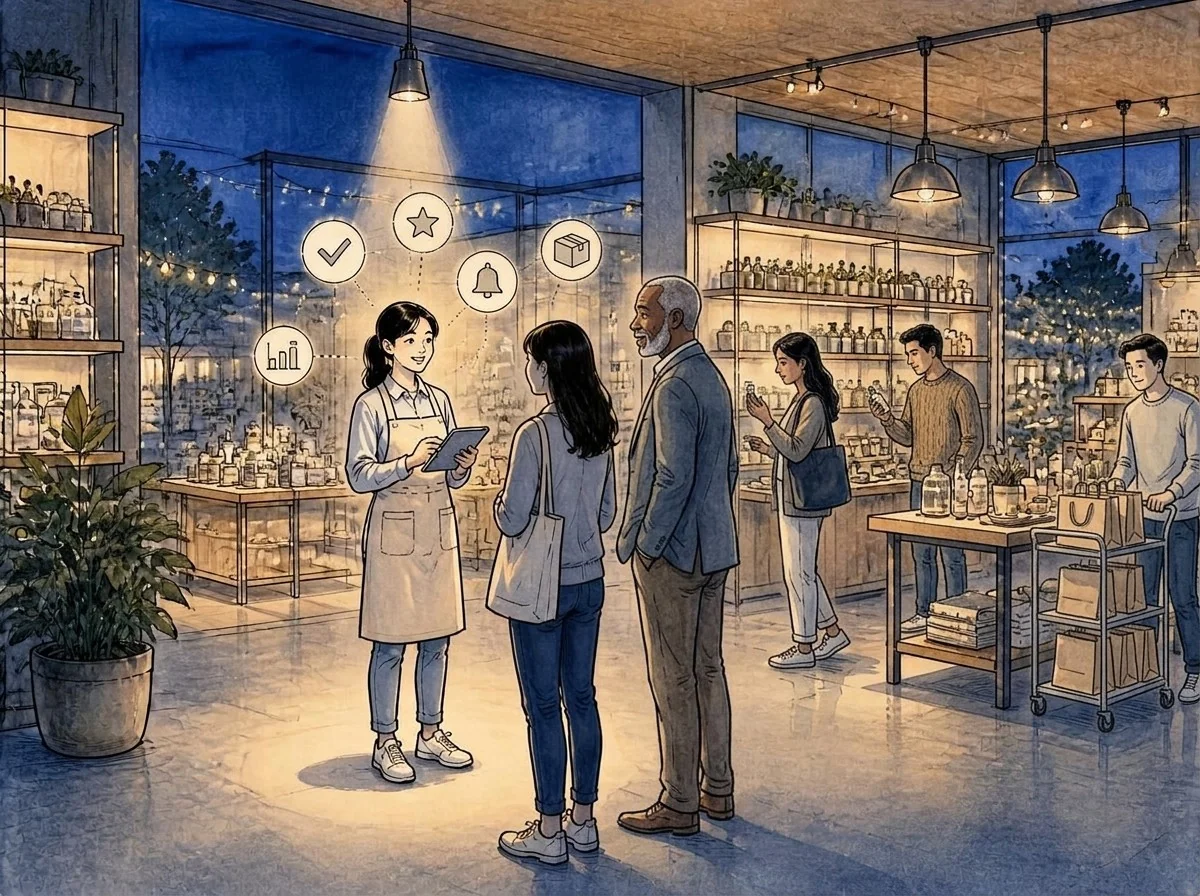
The bigger opportunity is connecting content to store operations. Advertising, pricing, promotions, inventory, and loyalty shouldn't operate independently. If a product is unavailable or an offer expires, the messaging needs to reflect that.
Retailers have spent years trying to unify commerce. Now they're introducing another ecosystem of advertising platforms, manufacturers, and technology providers. Those connections need to work before retailers start adding more messages to the store.
What We Want to Investigate
When Does More Become Too Much?
Think about advertising at a sporting event. From the boards around a hockey rink to sponsored entertainment throughout an arena, advertising is almost everywhere. Some adds to the experience, some becomes background noise, and some you barely notice.
Retailers could face a similar challenge. If the first few displays generate revenue, why not add another ten or twenty? But when every aisle becomes advertising space, does that change what customers liked about the retailer?
Our CRA/Pollfish Checkout Series survey of 500 U.S. shoppers offers a caution. Among respondents who encountered sponsored checkout advertisements, 58.6% rated them annoying or very annoying. And 69.6% selected a clear "skip" or "no thanks" option for unwanted checkout prompts.
Those findings concern checkout interactions, not advertising throughout the store. Still, they raise a question about control. Could connected retail media eventually give shoppers more say in what they encounter?
Advertising can create value, but retailers need to consider whether additional revenue justifies its impact on the experience they've built.
Help Me or Sell Me Something Else?
As retailers find more ways to reach shoppers, they're also finding more ways to learn about them. Connected displays can provide recipes, comparisons, and demonstrations, but they might also encourage customers to scan a QR code, connect a loyalty account, or share personal information.
Loyalty programs have operated on a similar principle for years, offering discounts and rewards in exchange for information. The question is what customers receive when that relationship moves into an increasingly connected store.
Advertisers want to know whether customers engaged with their content and whether campaigns increased sales. Some of that can be measured through aggregated information without identifying individual shoppers. Understanding personal preferences and shopping histories introduces another level of data collection.
Retailers need to explain what information they're collecting, who can use it, and why customers should share it. Could shoppers eventually manage advertiser permissions across digital and physical channels?
A connected store doesn't have to mean a constantly monitored store.
From Advertising Space to Brand-Funded Experiences
In our earlier look at experiential retail, we explored PUMA's interactive shoe wall developed by Outform. Pick up a shoe, and the display responds with product information.
Now imagine that technology inside a retailer carrying PUMA, Nike, Adidas, and several other brands. Who decides what appears? Do manufacturers provide content, fund the technology, or purchase dedicated areas where they create their own experiences?
It's similar to the store-within-a-store model in department stores or food halls. Each brand has its own identity, but someone still brings everything together.
Sam's Club offers a real example of retail media moving in this direction. During the 2025 IndyCar season finale in Nashville, its Member Access Platform and Andretti Global developed Race to the Club, bringing racing-themed experiences to three Sam's Club locations and the Nashville Superspeedway Fan Zone. Activities included simulators, driver appearances, product demonstrations, sampling, and a concert.
It shows what becomes possible when manufacturers and retailers collaborate on experiences rather than simply purchasing advertising.
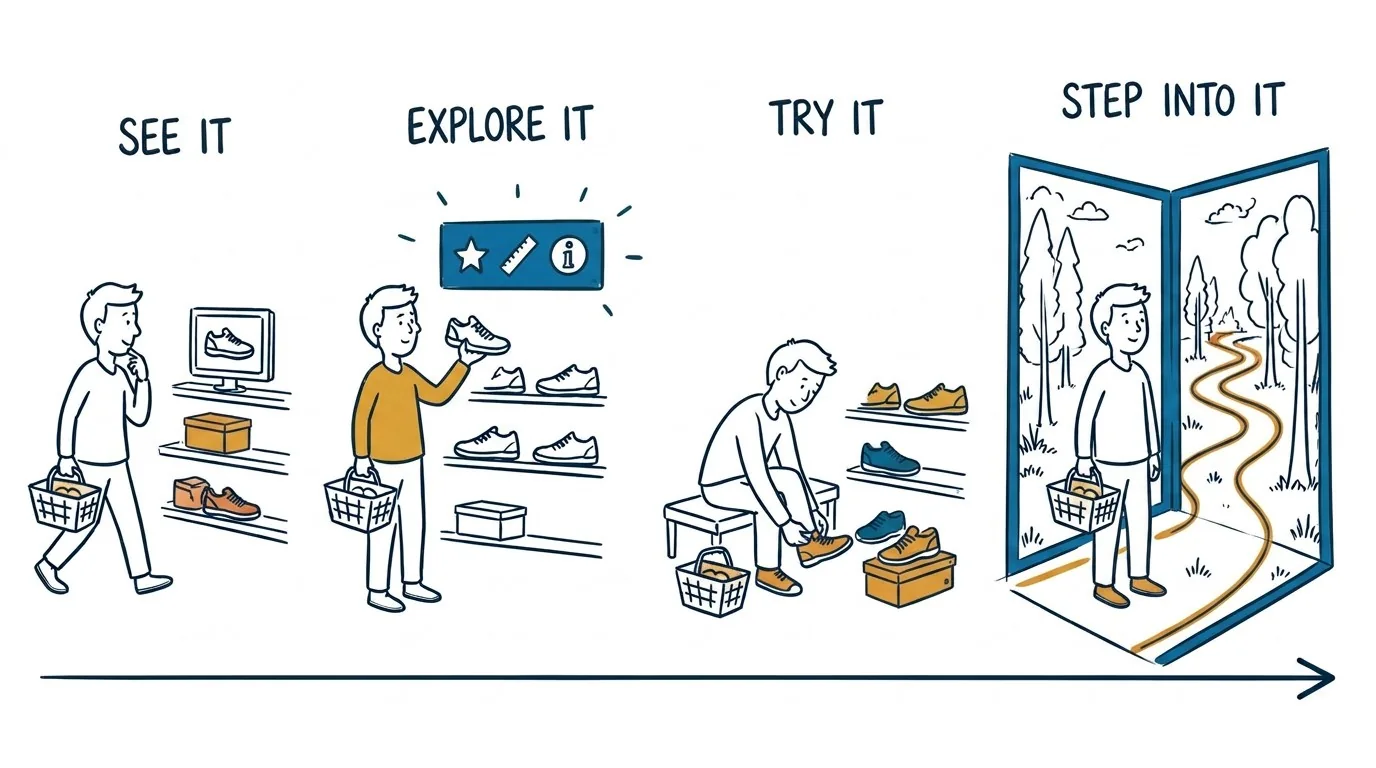
Think of it as See It → Explore It → Try It → Step Into It. A customer might discover a product through advertising, explore it through interactive content, try it through a demonstration, or enjoy a sponsored attraction.
And not everything needs to come from national manufacturers. Trader Joe's hand-drawn signage and Wawa's associate-designed holiday cup show how local creativity gives stores personality. Connected content could offer employees and communities another way to contribute.
The opportunity isn't making every store more elaborate. It's creating something that still feels like the retailer customers came to visit.
The Operating Model: Who Runs It, and Who's Accountable?
Connected displays, digital endcaps, and interactive experiences sound great. Someone still has to keep them working.
Imagine a manufacturer paying to advertise across hundreds of stores. The campaign reports thousands of successful plays, but some displays are dark, others obstructed, and a few promote unavailable products. Did the advertiser get what it paid for?
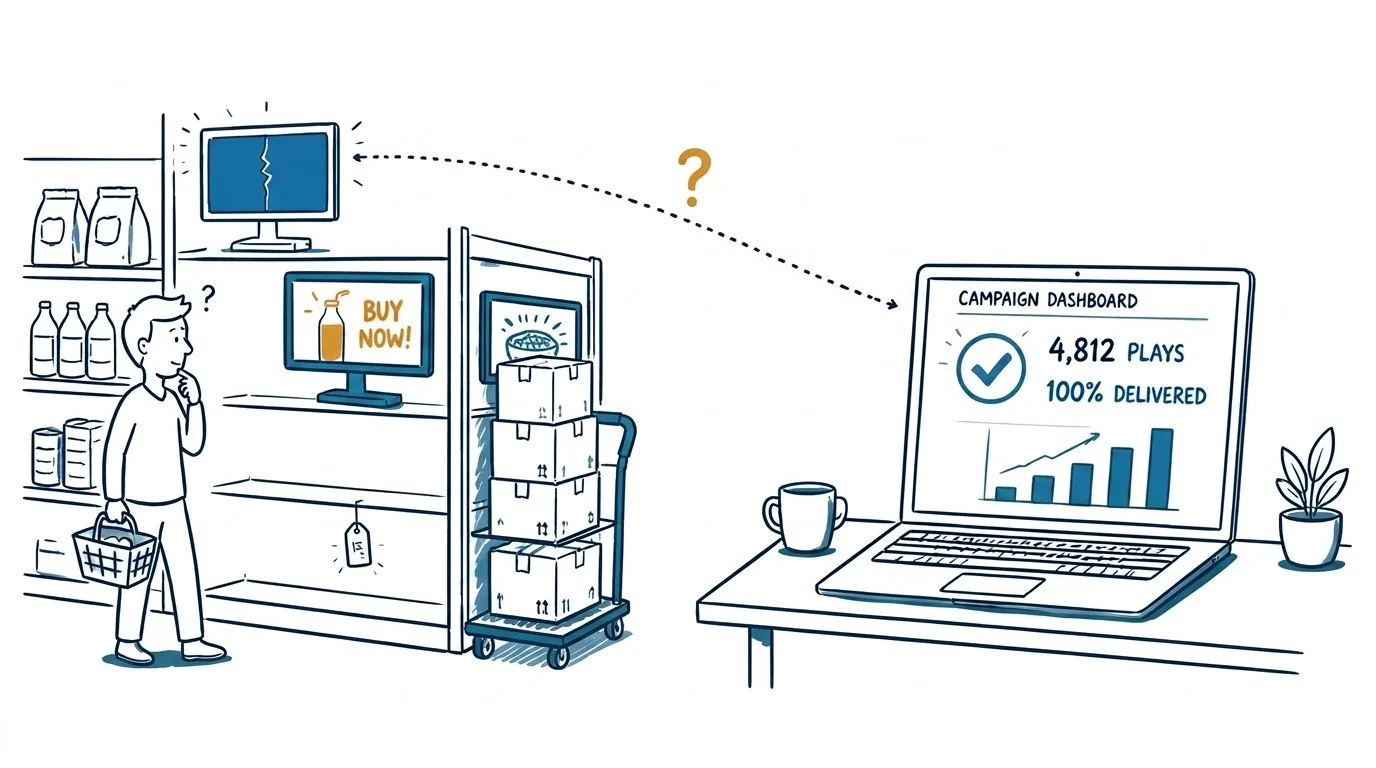
Anyone who's struggled with connectivity inside a mall or stadium knows reliable networking isn't guaranteed. Add digital signage, smart carts, cloud applications, and customers using their phones, and that's more demand on infrastructure already supporting store operations.
Control matters, too. Marketing wants advertising revenue, manufacturers want visibility, merchandising has promotions to manage, and IT needs everything working. If an advertised product is out of stock, can the retailer replace that content without conflicting with its agreement?
And what happens when the technology provider changes direction?
Instacart recently announced it was winding down its Caper Cart business. Imagine being a retailer that invested in the technology and expected to use it for years. Existing carts don't necessarily stop working immediately, but the announcement raises questions about long-term support.
Could another company maintain the equipment? Should retailers negotiate access to technical documentation, source-code escrow, or other protections?
The same applies to manufacturer-funded experiences. If a sponsor leaves, can another brand use the installation? Who owns the equipment, and who pays to maintain it?
The retailer may own the store, but who's ultimately controlling the experience customers receive?
What We're Watching at NRF 2027
There will be plenty of connected displays and interactive demonstrations at Javits. What I'm interested in is how these technologies work in actual stores, what retailers are learning, and whether the economics make sense.
Commerce Media Saturday, January 9 at Lavan Midtown, explores retail media's expansion into broader commerce media. We're interested in manufacturer budgets, business models, and whether advertising can help finance connected experiences.
The Next Era of Digital Retail: From Connected Stores to Adaptive Experiences, January 10, brings together Sephora and Outform to discuss an ongoing pilot connecting product discovery, customer insights, physical experiences, and media.
Also on January 10, What If Retail Becomes Entertainment First, Commerce Second? features VS & Co., PepsiCo, and Gap. This connects directly to manufacturer-funded attractions and experiences that give customers reasons to visit.
The Last Digital Frontier: Reinventing the Physical Store, January 12, examines smart carts, customer engagement, store operations, and measurable retail media.
The two Sunday sessions overlap, but both offer useful perspectives.
A Few Companies Worth Exploring
Several companies are worth investigating on the show floor, each approaching a different part of connected retail media.
- VusionGroup (Booth 4839, Level 3) — Connected shelf technology, electronic shelf labels, and retail media. How can advertising stay aligned with pricing, promotions, and inventory?
- Creative Realities, Inc. (Booth 2201, Level 1) — Digital signage, content management, and retail media. How are campaigns managed and reliably delivered across locations?
- Ergonomic Solutions / SpacePole (Booth 3447, Level 3) — Mounting and installation infrastructure. How do retailers address accessibility, security, maintenance, and equipment replacement?
- dunnhumby (Booth 6305, Level 3) — Customer strategy, loyalty insights, personalization, and measurement. Can customer insights determine where retail media actually adds value?
- Cust2Mate (Booth 4846, Level 3) — Connected shopping, smart-cart advertising, and shopper insights. Can these capabilities improve the shopping trip without introducing more distractions?
These are companies worth investigating, not endorsements.
Five Questions to Bring to a Booth
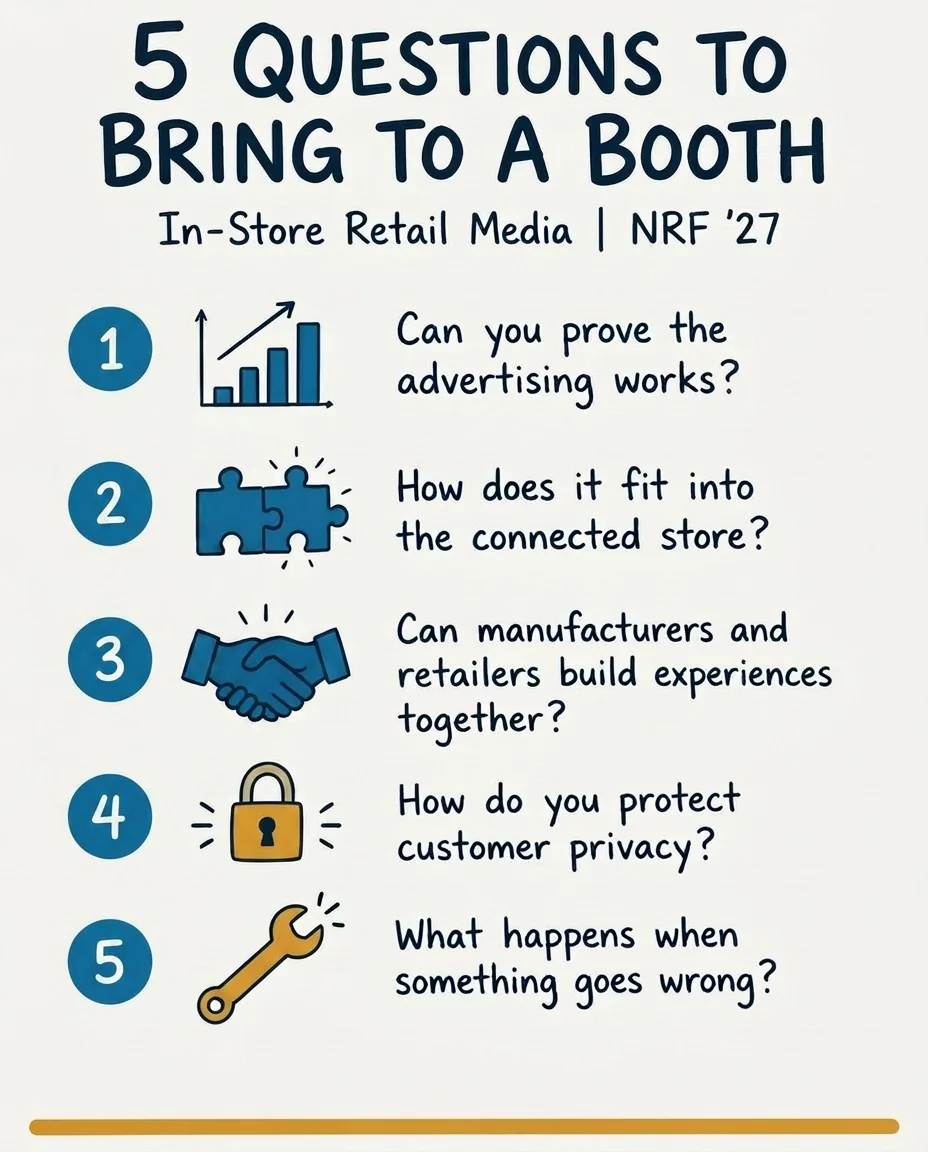
As we explore these solutions, here are five questions I'd encourage retailers to ask:
- Can you prove the advertising works? Show us incremental sales and return on investment beyond playback counts.
- How does it fit into the connected store? Does it work with pricing, inventory, loyalty, and POS?
- Can manufacturers and retailers build experiences together? Who controls content when competing brands participate?
- How do you protect customer privacy? What information is necessary, who uses it, and what choices do shoppers have?
- What happens when something goes wrong? Who supports the technology when equipment fails or partnerships end?
I'd also ask vendors to show what happens outside ideal demonstration conditions. Technology that looks impressive at Javits still needs to work on a crowded Saturday afternoon when customers and associates depend on it.
The Road Ahead: The Experience We're Building
I'm sure we'll see some impressive displays and interactive experiences at Javits. Some will probably make us stop and take a closer look. But when the demonstration is over, I want to understand how that technology works inside a real store, whether customers find it useful, and what happens when something goes wrong.
Retail media could help fund better stores, stronger manufacturer partnerships, and experiences that give customers more reasons to visit. It also brings new responsibilities, from protecting customer attention and privacy to maintaining technology over time.
After years of working toward unified commerce, retailers shouldn't create another disconnected environment just because there's advertising revenue available.
Are we designing retail media around the customer journey, or asking customers to navigate around our retail media?
That's one of the questions we'll be bringing to Javits.
THE LENS
The short version for your next meeting.
The key points, what to try, and the question to ask your team. Free PDF. No form.
Get The Lens