


The Business Challenge: The Associate Is on Stage
Think about the last time you walked into a store and encountered an associate who really knew their business.
Maybe it was someone at a hardware store who helped you find the right part without searching through a computer. Or a department store associate who remembered your preferences, recommended something you hadn't considered, and made the experience more enjoyable.
Those interactions didn't require the latest technology. They required knowledgeable people who had the time, confidence, and freedom to connect with customers.
Today, we're asking those same associates to do considerably more.
Depending on the brand and the experience it wants to deliver, associates might be responsible for checkout, inventory, online fulfillment, curbside pickup, returns, merchandising, fresh food preparation, and other operational tasks. They're also managing team communications, performance measurements, and notifications from tablets, handhelds, and point-of-sale systems.
Somewhere in that growing list of responsibilities, they're still expected to deliver a great customer experience.
Are we giving associates the tools to succeed, or simply making them responsible for more work?
In our previous Walking Into Javits article, we explored how stores are becoming more experiential, connected environments. Retailers are investing in interactive displays, community spaces, and new ways to engage customers. But associates are the people bringing those experiences to life, helping customers connect with a brand's culture, understand what it stands for, and become part of its community.
A flagship might deliver that experience differently from a neighborhood store, but investing in the people who make it happen is something every retailer can scale.
You can build a great environment, but the people working there help determine whether it becomes a great experience.
The Business Questions: What Are We Actually Trying to Improve?
Retailers have invested heavily in store technology. Those investments have helped, but they also raise some questions.
Are associates spending more time engaging with customers or managing applications? Are we simplifying their responsibilities or simply digitizing an increasingly complicated workday? And when technology saves time, how are we using that additional capacity?
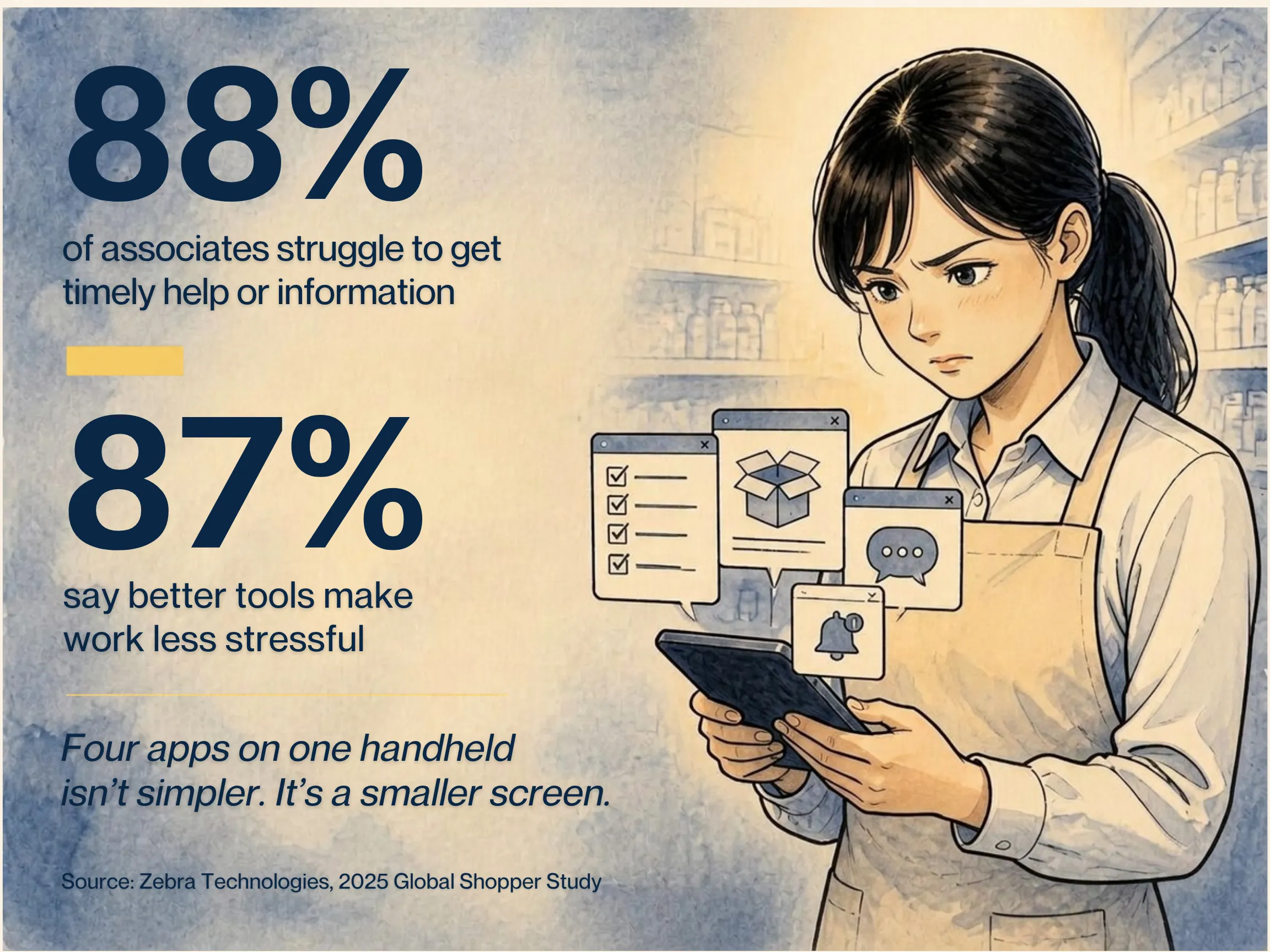
Zebra Technologies' 2025 Global Shopper Study found that 88% of surveyed retail associates reported challenges obtaining timely assistance or information, up from 82% the previous year. At the same time, 87% believed better tools make their work more enjoyable and less stressful.
There's an interesting disconnect here. Put four disconnected applications onto one handheld, and we haven't simplified anything. We've just moved the complexity onto a smaller screen.
Before investing in another application or device, retailers should understand the experience they're trying to create for their associates and ultimately their customers.
What's Changing: Technology That Supports the Workday
Unified mobile workspaces. Retailers are bringing inventory information, customer history, fulfillment, task management, and checkout capabilities together. At Tom Ford Fashion, associates use mobile tools to access information and complete transactions without leaving the customer. According to technology partner KWI, transactions that previously took 10 minutes can now be processed in seconds.
But one device doesn't automatically create a seamless experience. The systems behind it still need to communicate, and associates shouldn't spend the entire interaction looking down at a screen.
AI-assisted guidance and task management. Walmart has introduced AI-powered associate tools supporting daily tasks and shift planning. In an initial overnight stocking implementation, team leads and managers estimated that planning time dropped from 90 minutes to 30.
Imagine a system recognizing increased customer traffic, identifying tasks that can wait, and helping a manager arrange additional support.
Is anyone actually doing this yet? That's one we want to find out at Javits.
Automation and operational efficiency. RFID, computer vision, automated cash management, and connected inventory systems can reduce repetitive work. But are we actually eliminating tasks or creating another digital checklist?
What happens to the hour an associate no longer spends counting inventory? If it goes straight to another task list, nothing changed for the customer.
Continuous learning and knowledge. Associates need access to product information, policies, and training without constantly stepping away from customers. AI-assisted knowledge tools and short, targeted learning sessions can help employees answer questions, develop skills, and learn from teammates while supporting their daily responsibilities.
The question across all four areas is the same: What becomes possible for the associate that wasn't possible before?
What We Want to Investigate: Designing Around the Real Store
When Efficiency and Customer Experience Compete
Consider an associate fulfilling a digital grocery order. They're likely measured on picking speed and accuracy when a customer stops them for assistance. Helping that customer may affect their fulfillment time.
The same conflict happens in restaurants. Drive-through performance matters, but so does the customer standing at the counter. Accept too many orders without adjusting capacity, and employees get overwhelmed, details get missed, and service slows down.
These are legitimate operational measurements. The question is whether they support everything we're asking associates to accomplish.
You can hit a KPI without creating much value.
So yes, you got one more order out the door. But if doing so meant seven other customers received a poor experience, what did you really gain? Picture someone walking into a long line of frustrated customers waiting on online orders. That's not a good vibe, and they notice.

Giving Associates Clear Priorities and Room to Adapt
When an associate is on the sales floor, they're on stage.
Some customers want to get in and out quickly. Others want product expertise, assistance, or a more personalized experience. Associates need the flexibility to recognize those differences.
Cross-training helps. An inventory specialist might answer a customer's question, while someone focused on customer experience could assist with replenishment when activity slows.
Everyone is on stage. Their priorities are just different. One associate may be front and center, focused on customers. Another is focused on operational work, but their 1B is helping a customer when needed and knowing when to bring in the person whose role is customer engagement right now.
Leadership decides those priorities, which can shift by daypart or traffic. Scheduling and task tools should support that, not fight it.

Flexibility doesn't eliminate accountability. It helps teams manage competing priorities.
Developing People, Not Just Completing Tasks
Not everyone brings the same strengths to the job. Some people are great at inventory and operations. Others naturally connect with customers, know their products inside and out, or enjoy leading activities and workshops. Why not give them opportunities to learn from each other and build on what they already do well?
As stores become more involved in their communities, associates could also help extend the experience beyond the store. Maybe someone enjoys creating social media content, promoting a local event, or sharing what makes their store and brand different. Give them the right tools, some guidance, and room to try it.
If we're asking associates to take on new responsibilities, we should recognize what they're contributing and give them opportunities to grow.
Building a better store experience should also mean building a better place to work.
Design the Associate Journey Before Selecting Technology
This brings us back to the question from our first Walking Into Javits article: What journey are you trying to improve?
Before putting together an RFP or sitting through vendor demonstrations, figure out what you want the associate's day to look like. What are they responsible for? What should come first? Where are things getting in the way of helping customers?
Don't make those decisions without the people who actually work in the stores.
Bring in store managers, experienced associates, and people from operations and training. Listen to customers, too. Let associates participate in vendor demonstrations, ask questions, and walk vendors through situations they deal with every day.
And maybe leadership needs to spend more time on the floor, too. Not just walking through the store, but working alongside associates during a busy shift. The same goes for consultants and the teams helping design these solutions. Try picking orders, replenishing shelves, or helping customers while keeping up with everything else going on. You might discover a few things that never came up during planning.
Then keep associates involved through design, testing, rollout, and after the technology is in place. They're the ones who notice when something takes too many steps, doesn't work during a rush, or creates more work than it eliminates.
Even people with years of retail experience can lose touch with a busy store shift. That's why bringing people who deal with those challenges every day into the process matters.
What Happens When Technology Doesn't Work?
Vendor demonstrations typically show ideal conditions. Stores don't always work that way.
Handheld devices lose connectivity. Batteries die. Inventory information can be inaccurate. Applications freeze.
Can an employee continue helping the customer? Is there a backup process? Can another associate take over? How quickly can the store recover?
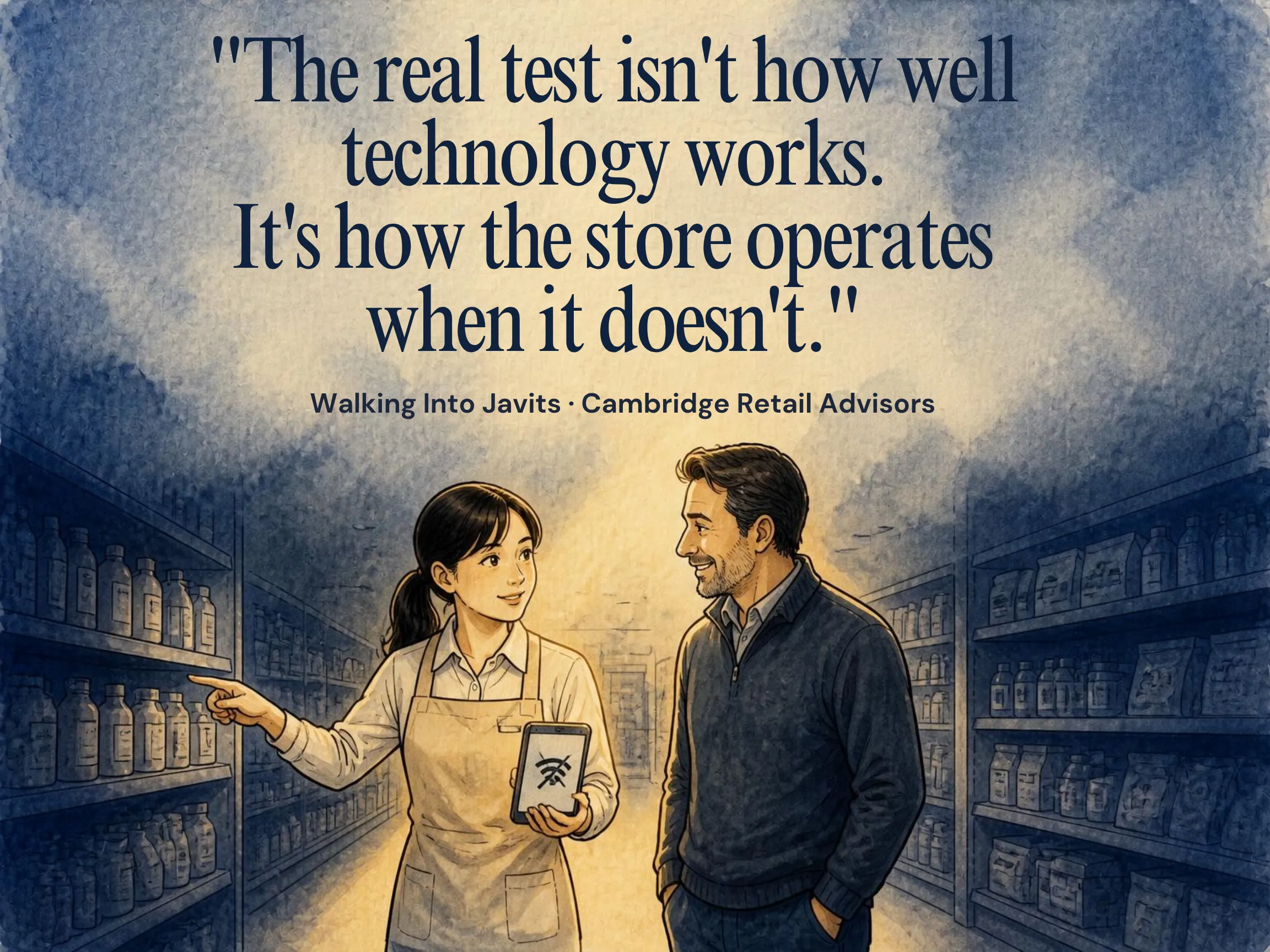
The real test isn't only how well technology works. It's how the store operates when it doesn't.
What We're Watching at NRF 2027
One Store, Infinite Roles: Empowering the Modern Retail Associate
Sunday, January 10 | 10:45–11:15 AM | HP Stage, Javits North, Room 411
Samsung Electronics America's Tyler Gipson and EssilorLuxottica's Tommaso Tebaldi. We're interested in how connected tools simplify the workday without adding complexity.
Frontline First: AI for the People Who Make Retail Run
Sunday, January 10 | 11:15–11:45 AM | AI Stage by Klaviyo, Expo Level 1
Nebraska Furniture Mart's Robyn Messerly and HP's Cliff Gumkowski. Which capabilities are producing meaningful results today, and how are retailers measuring their impact?
Closing the AI Execution Gap in Store Operations with Ulta Beauty
Sunday, January 10 | 1:00–1:30 PM | HP Stage, Javits North, Room 411
ServiceNow's Ellie Quartel and Ulta Beauty's Mark Martynus. We're interested in how retailers handle exceptions and support associates when automated processes require human intervention.
A Few Companies Worth Exploring
Zebra Technologies (Booth #3303, Level 3) — Enterprise mobile devices, RFID, inventory visibility, and AI-assisted workflows.
Axonify (Booth #3229, Level 3) — Frontline microlearning, skills development, and operational coaching without constantly pulling associates away from daily responsibilities.
StoreForce (Booth #1927, Level 1) — Workforce management, scheduling, and store execution aligned with traffic and customer engagement.
UKG (Booth #5826, Level 3) — Workforce management, scheduling, timekeeping, and payroll. Worth exploring how labor tools are adapting as associates take on more roles.
Workday (Booth #5415, Level 3) — Workforce planning, scheduling, HR, and employee development. Worth exploring how staffing and cross-training connect to store operations.
42Gears (Booth #3783, Level 3) — Mobile device management, security, and fleet support across large retail networks.
Zipline (Booth #5451, Level 3) — Store communications, task execution, and AI-assisted information access to clarify priorities and reduce communication overload.
These are companies worth investigating, not endorsements.
Questions to Bring to a Booth
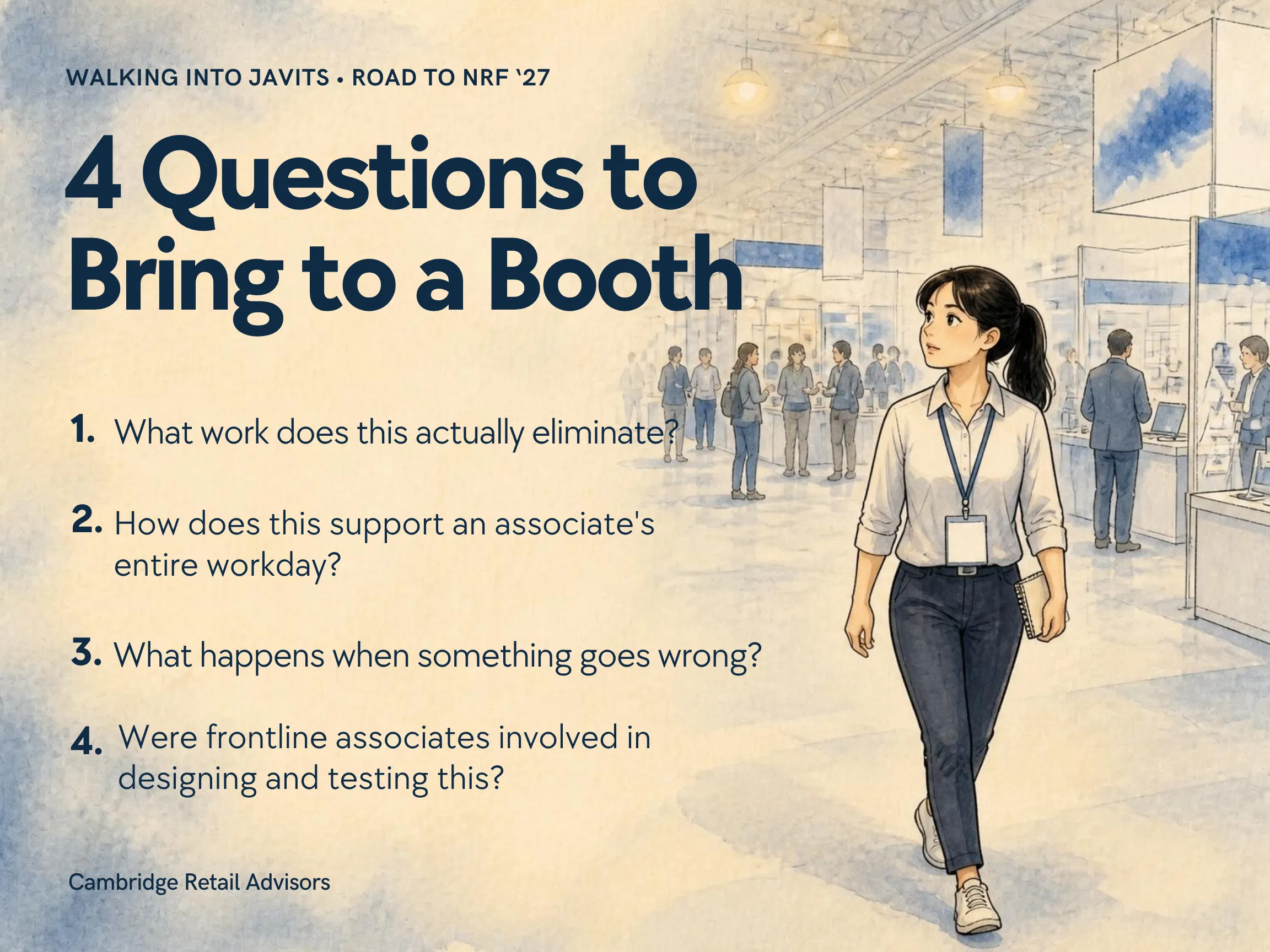
- What work does this actually eliminate? Show us the tasks, duplicate processes, and unnecessary steps that disappear.
- How does this support an associate's entire workday? Show us the transitions, including when priorities change.
- What happens when something goes wrong? How does it handle lost connectivity, inaccurate information, or an interrupted workflow?
- Were frontline associates involved in designing and testing this? What did they challenge, and what changed because of it?
The Road Ahead: Technology Should Make Room for People
Retailers shouldn't have to choose between operational efficiency and customer experience. The opportunity is to build an environment where one more order out the door doesn't come at the expense of seven other customers.
The best frontline technology may be the technology that gets out of the associate's way.
If an associate can help a customer and complete a purchase anywhere, where does checkout actually happen?
That's what we're hoping to learn as we walk into Javits.
THE LENS
The short version for your next meeting.
The key points, what to try, and the question to ask your team. Free PDF. No form.
Get The Lens