



One of our partners at Cambridge Retail Advisors remembers a customer coming into his Verizon store with a serious billing issue. They were disputing charges related to their services and usage, and they were frustrated enough to threaten to leave. He let them talk through what was happening. It was clear pretty fast that this wasn't just a matter of looking at the latest bill.
It took some digging. He reviewed the account history and previous conversations, worked with customer service and technical support, and involved his district manager to piece together what had happened. They eventually found issues on both sides. Some involved the customer's usage, while others traced back to how services had originally been set up.
It took more than one visit to identify the root cause, stop the problem from continuing, and reach a resolution both sides could accept. The customer didn't get every charge removed, but they understood what happened and could see someone was working hard to fix it.
Some of his longest customer relationships started with situations like that. A customer came in ready to leave, and taking the time to understand the problem gave them a reason to stay. It's the same approach we take at CRA today. You have to understand what's happening before you can find the root cause.
Know What You're Trying to Improve
Most retailers heading to Javits already have initiatives in mind. Maybe it's a POS or ERP replacement, a new pricing engine, improvements to loyalty or checkout, or exploring AI agents, retail media, and other technologies. Some have detailed roadmaps, others are still working through their priorities, and many are somewhere in between.
Before getting into demonstrations and vendor conversations, think about the two or three initiatives that matter most to your business. Not a hundred-page requirements document, but a clear understanding of what you're trying to accomplish. What customer or associate experience needs improvement? Where are you losing time, creating unnecessary work, or missing opportunities to generate revenue?
Think about both the near and long term. You may be able to make meaningful improvements without waiting three or four years for a platform replacement. At the same time, today's decisions should support where the business wants to go, whether that's new store formats, acquisitions, partnerships, or different ways of engaging customers.
Bring Different Perspectives Into the Conversation
One thing we've seen over the years is how different teams can look at the same initiative and see different priorities. Operations, merchandising, IT, architecture, customer experience, and product owners all bring something valuable.
Consider involving a store manager or someone from your frontline operations team whom you respect. Many technology leaders have store experience themselves, but there's value in having someone who deals with these situations every day look at a solution and ask, "Okay, but what happens when this occurs? What about this situation?"
Don't just ask whether they like the screens. Have them think through the workflow. How does it work on a busy Saturday? What happens when something goes wrong? Does it make their job easier, or are we adding another task? They don't necessarily need to attend NRF. They can help shape the questions beforehand or review solutions afterward.
There's also value in an outside perspective. That might be a consulting partner, an industry colleague, or someone you trust who knows an area your team hasn't explored. Sometimes their best contribution is being a fly on the wall, listening and asking a question nobody else thought to ask.
And yes, full transparency: we're a consulting company, and we'd love your business. But whether it's CRA or somebody else you trust, bring people who can challenge an assumption and help you see something you might otherwise miss.
The Happy Path Is Only Part of the Story
Let's take checkout. The customer finds what they need, promotions and loyalty benefits apply, payment goes through, inventory updates, and they're on their way. Everything works as expected.
But we've all seen what happens when a promotion doesn't apply correctly, a loyalty card won't scan, or a pin pad isn't cooperating. Now the associate has to manually adjust the price, enter the loyalty information another way, or figure out how to complete the payment through an alternate process. Some of us remember the old days of entering card information directly into the POS.
Operations has probably developed a workaround and trained associates on what to do. But what happens when someone is new, hasn't encountered that issue before, or doesn't know the steps? They're looking for another associate or a manager while the customer waits and the line grows.
Or maybe you've got one system speaking Pig Latin and another speaking Klingon. They both work perfectly well on their own, but they don't understand each other.
Explore these situations with vendors. Can the associate resolve the issue without starting over? What happens when information doesn't transfer correctly? Does the solution simplify the workaround, or are we introducing another process that everyone needs to learn?
You can't anticipate every exception, and you don't need to. Focus on the ones that happen frequently or create the greatest friction. Think back to that Verizon customer. Resolving the issue meant connecting information from different sources and working across departments. Better tools could have made that process faster, but someone still needed to understand the problem and work toward a resolution.
The ROI Matters. So Does Getting People On Board.
Technology investments need to deliver business value. That might mean time saved, lower costs, increased sales, or new revenue opportunities through retail media, loyalty, and other capabilities. But there's another question to consider: who else benefits?
If a solution generates additional revenue, could associates share in that success through incentives, bonuses, or recognition? If customers are being asked to use something new, what are they getting in return? Maybe it's convenience, better loyalty benefits, or an experience they couldn't get before.
Another lesson comes from the days when selling tablets became a major focus at Verizon. Tablets, tablets, tablets. One of our partners remembers how easy it became to recommend one, particularly when promotions made the tablet itself free. But why should the customer take it? What were they going to use it for? Did it fit their needs?
You can hit a KPI without creating much value. And if you're evaluating a new solution at NRF, ask the vendor: What does the customer get, and what does the associate get?
An AI agent might look great in a demonstration. A new checkout solution might shave time off a transaction. But will people trust it and use it? What changes when you move from a pilot to hundreds of stores? Something working in a demo doesn't mean your associates and customers will buy into actually using it when it's rolled out.
Take Those Questions to Javits
You may already know what technology you're looking for, or you may be exploring what's possible. Either way, bring a few priorities and some real-world situations you want to understand better. Look at the major platforms, but leave room for smaller vendors and ideas you hadn't considered.
Here are three questions to take into those conversations:
- Can you show us what happens when something goes wrong? Not just the ideal demonstration. Show us how an associate or customer gets through an exception.
- What does this change for the customer and the associate? What gets easier, what gets added, and where does the value come from?
- What would it take to make this work in our environment? Think integrations, existing systems, training, and what changes between a pilot and a broader rollout.
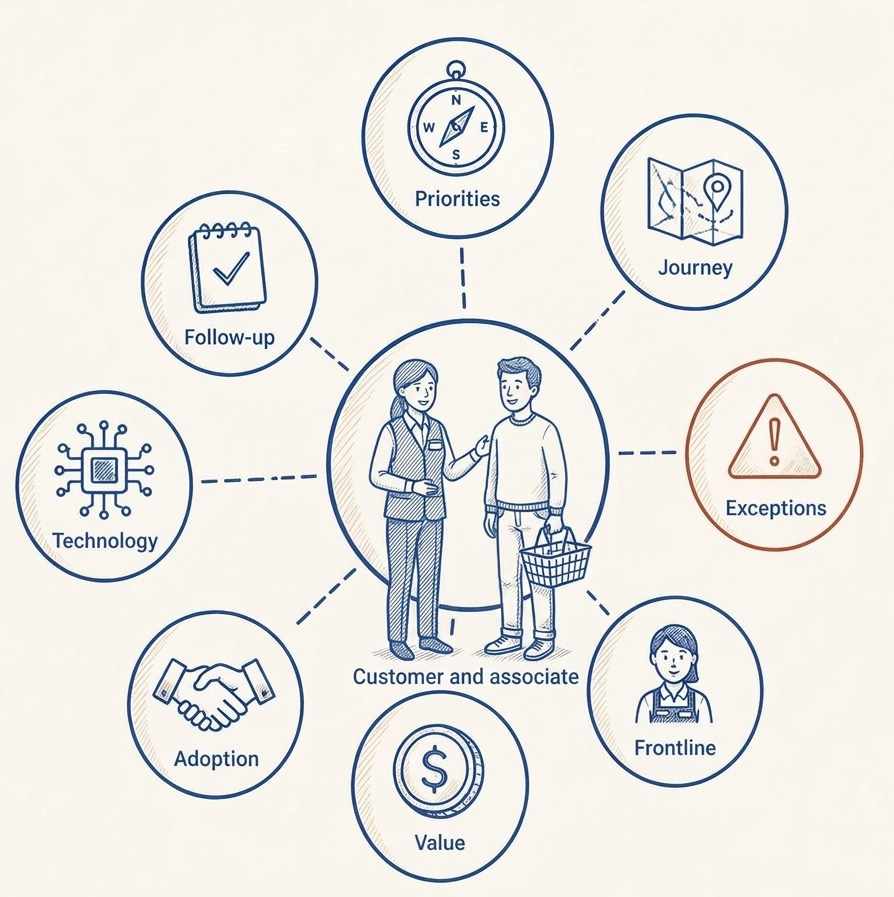
To help organize those thoughts, we're developing a CRA Technology Exploration Guide. It will walk through your priorities, customer and associate journeys, common exceptions, business value, and adoption considerations, with a summary you can use in vendor conversations.
You don't need every answer before walking into Javits. Come with a few problems worth solving.
THE LENS
The three-page version for your next meeting.
The key numbers, three things to try, and the question to ask your team. Free PDF. No form.
Get The Lens

