

AI, checkout, and payments are three topics I expect we'll hear plenty about at NRF 2027. Whether it's during conference sessions or conversations with vendors on the show floor, there's a lot happening in these areas.
From intelligent self-checkout to AI shopping assistants and agentic commerce, retailers will have plenty to look at. Some of these technologies are already in use, while others could change how customers shop.
But I think there's a bigger opportunity here.
What if AI agents could do more than simply help customers complete a transaction? What if they could also help retailers and customers work together to create a better shopping experience? That's one of the questions I'll be bringing to Javits.
Where AI Is Making a Difference Today
While agentic commerce is getting much of the attention, there are already practical uses of AI at checkout that I'd encourage retailers to kick the tires on at Javits. Computer vision is helping retailers improve self-checkout by recognizing mistakes and allowing customers to correct them without always needing an associate.
Kroger, for example, has worked with Everseen on visual AI at self-checkout. According to a Lenovo case study, more than 75% of self-checkout errors are corrected without employee intervention. Toshiba has been developing similar capabilities through its ELERA technology, while GK Software has introduced AI tools designed to make store employees' jobs easier.
These technologies also challenge the negative picture some people have of AI. There's a concern that retailers will use it to cut jobs and replace associates with robots, eventually turning stores into places with little or no human interaction.
Nobody wants to walk into a store that's become a ghost town filled with robots.
But these examples show another direction. AI can help shoppers resolve problems on their own while giving associates more time to focus on customers who need assistance. It doesn't mean retailers won't use automation to reduce staffing, but replacing employees doesn't have to be the objective.
As retailers rethink self-checkout, there's still a place for staffed lanes and self-service. Mobile POS offers another option. The right approach depends on the store and what the customer is trying to accomplish.
At NRF, GK Software (Booth 6002) and Toshiba (Booth 3623) are two companies I'd put on the list for anyone evaluating store technology.
Are their solutions reducing interventions? Are customers having an easier time checking out? And what have retailers learned after putting these systems to work?
Agentic Commerce: More Than Another Way to Buy
AI shopping assistants are already helping customers find products and figure out where to buy them. Now we're seeing these capabilities go further. Agents are beginning to help customers make purchasing decisions and, in some cases, complete transactions on their behalf.
Platforms like ChatGPT and Gemini are taking different approaches to AI shopping. Meanwhile, Adyen and PayPal are working on the payment capabilities that make these transactions possible. J.P. Morgan Payments and Stripe are also developing solutions in this area.
There's a difference between an AI assistant helping someone select a product and an agent independently making a purchasing decision. Some capabilities are already in use, while others are still being tested.
The NRF sessions should give us a better picture of where things stand. In Agentic Commerce: Lessons from Year One, Adyen will join SCHEELS and VF Corporation to discuss what they've learned from early implementations.
Another session, Fast-forward Agentic Commerce: When AI Agents Become the Buyer, will examine what retailers need to prepare for as AI takes on a greater role in purchasing.
But there's another question I'd like to ask: How might these agents work with retailers rather than just complete transactions for customers?
Take a general-purpose AI assistant like ChatGPT or Gemini. It might help someone research products across several retailers. A retailer's own AI assistant could take things further by knowing what's available in the store and understanding the customer's relationship with the brand.
What if the two could work together?
With the customer's permission, a personal AI assistant could connect with a retailer and share information that helps move the conversation forward. The retailer wouldn't have to start from scratch, and the customer wouldn't have to explain everything again.
And that doesn't mean the AI needs to complete the sale.
Bringing the AI Agent Into the Store
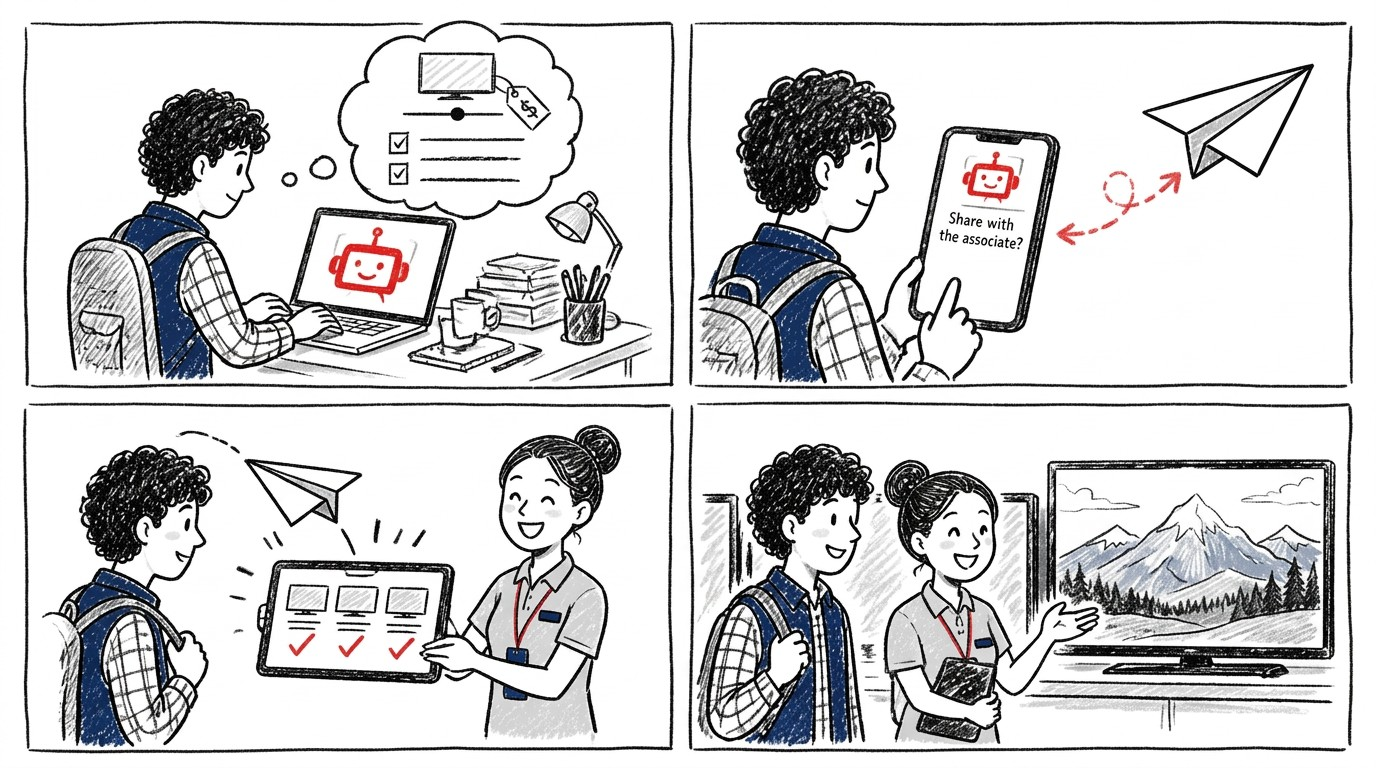
Think about someone who's shopping for a new television. They've spent the last few days working with an AI assistant to narrow their choices. They've talked through their budget and figured out which models might work best in their home.
Now they decide to visit Best Buy because they want to see a few televisions in person and talk with someone who knows the products.
Today, that conversation might start almost from scratch. The associate needs to understand what the customer is looking for before offering much guidance.
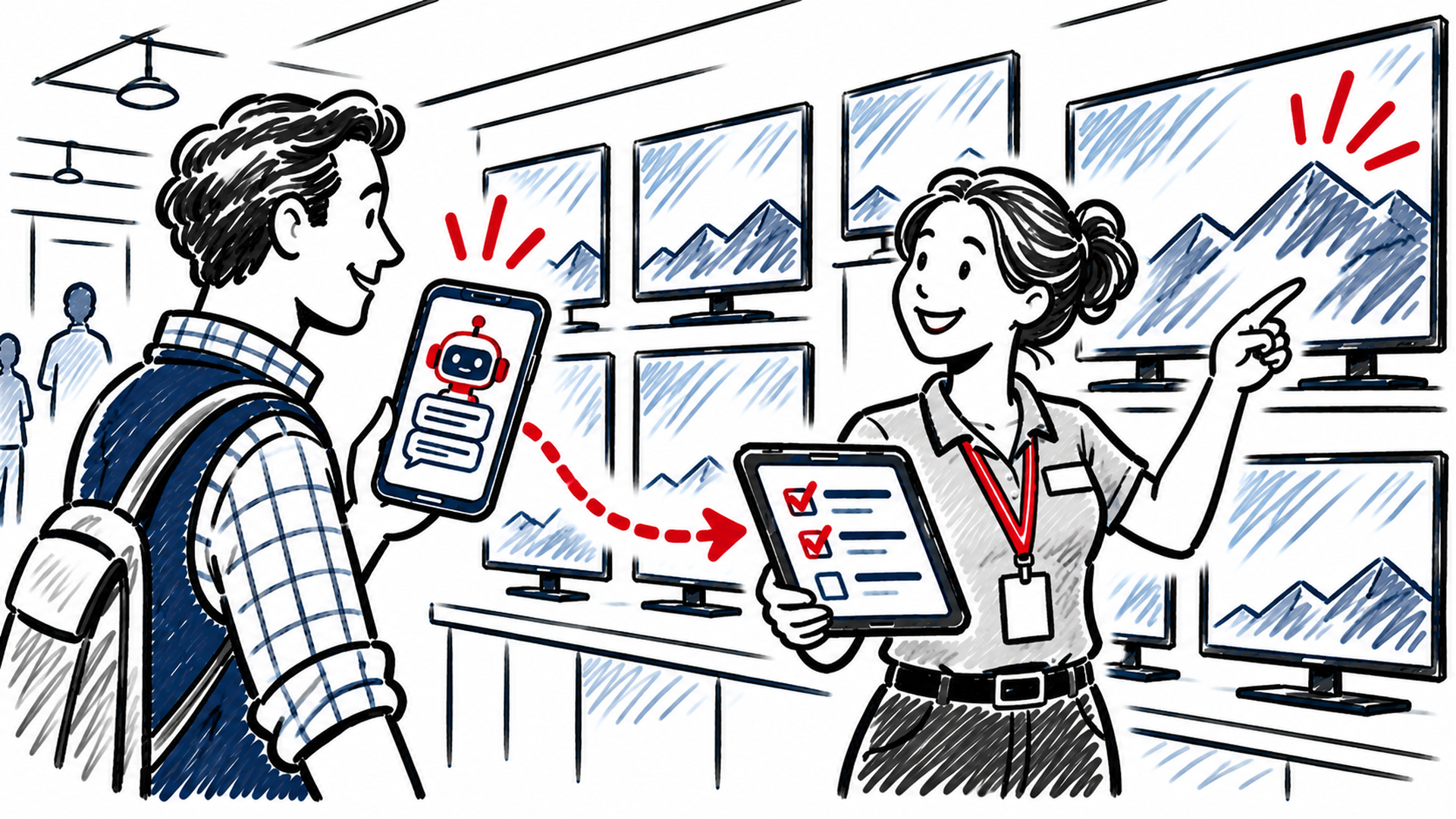
But what if the customer could give their AI assistant permission to share that information with the associate before they arrived? Instead of repeating the same conversation, they could spend more time looking at televisions and discussing what makes one model a better fit.
The agent could even stay involved. Maybe the associate wants to know why the customer ruled out a particular model. The AI could recall the earlier conversation, while the associate provides the hands-on experience and product knowledge that brought the customer into the store.
Of course, making this work raises some practical questions. How does the customer's AI share that conversation with the associate? Does the information appear on their handheld device? And can we make it happen without asking the customer to download another app or jump through a bunch of hoops?
I could see something similar happening in furniture retail. Imagine shopping at La-Z-Boy and using AI to visualize how a sofa would look in your living room. You could share pictures of the space and explore different configurations before visiting the showroom.
Once you're there, the associate could help you evaluate the choices and experience the furniture in person. You'd already have an idea of what you're looking for, but you'd still benefit from someone who knows the products.
These aren't fully connected experiences we're seeing everywhere today, but they give us a sense of where retail could go.
The agent doesn't have to replace the salesperson. It could help make the conversation better.
It could also close the gap between what happens online and inside the store. The customer wouldn't have to choose between working with an AI assistant and getting help from a real person.
What If the Opportunity Goes Beyond the Purchase?
Let's stay with the furniture example. You've purchased your sofa and recliner, but you're still trying to put the room together. Maybe you need artwork or someone to help with the design.
An AI assistant could help you discover a local art gallery or connect you with a designer whose work fits what you're looking for. Perhaps the furniture retailer already has relationships with businesses that could help.
Or consider a grocery store. Someone wants to prepare a special dinner for their family but isn't particularly experienced in the kitchen. An AI assistant could help develop the menu and figure out what ingredients are needed.
But what if the AI already knows what's in the customer's pantry and refrigerator? With permission and an accurate picture of what they have, it could plan the meal around those ingredients rather than creating a shopping list full of things they don't need.
The same idea could apply to someone's closet. Maybe there's an event coming up, and rather than recommending a new outfit, the agent helps put together something from clothes they already own.
Sometimes the best recommendation might be that the customer doesn't need to buy anything.
Now take the grocery example further. Maybe the store offers cooking classes or works with a local chef who could help the customer prepare that special dinner. Why couldn't the agent connect them?
The customer wanted to make a great meal for their family. Buying ingredients was only part of what they were trying to accomplish.
Retailers could use AI to introduce customers to expertise and experiences they might not otherwise discover. It could also create opportunities for local businesses to work together.
But are these agents helping customers find what they need, or are they becoming another way to push products and promotions?
There's a difference between helping someone make a good decision and constantly finding something else to sell them.
What Do Customers Actually Want?
How comfortable are customers with these technologies? In our Checkout Evolution research, we surveyed 500 U.S. consumers about their checkout experiences and preferences.
When we compared checkout formats with a traditional staffed lane, 45.6% chose a staffed checkout with AI assisting the associate. Only 26.8% chose the traditional staffed option in that comparison.
AI-assisted self-checkout also performed well. Nearly half of respondents, 49.4%, chose it over a traditional staffed lane, while 28.8% preferred the staffed option.
But the results were different when we asked who shoppers trusted more to charge them accurately. Just over half, 51.4%, selected a human associate. Only 11% selected AI, while 37.6% trusted both equally.
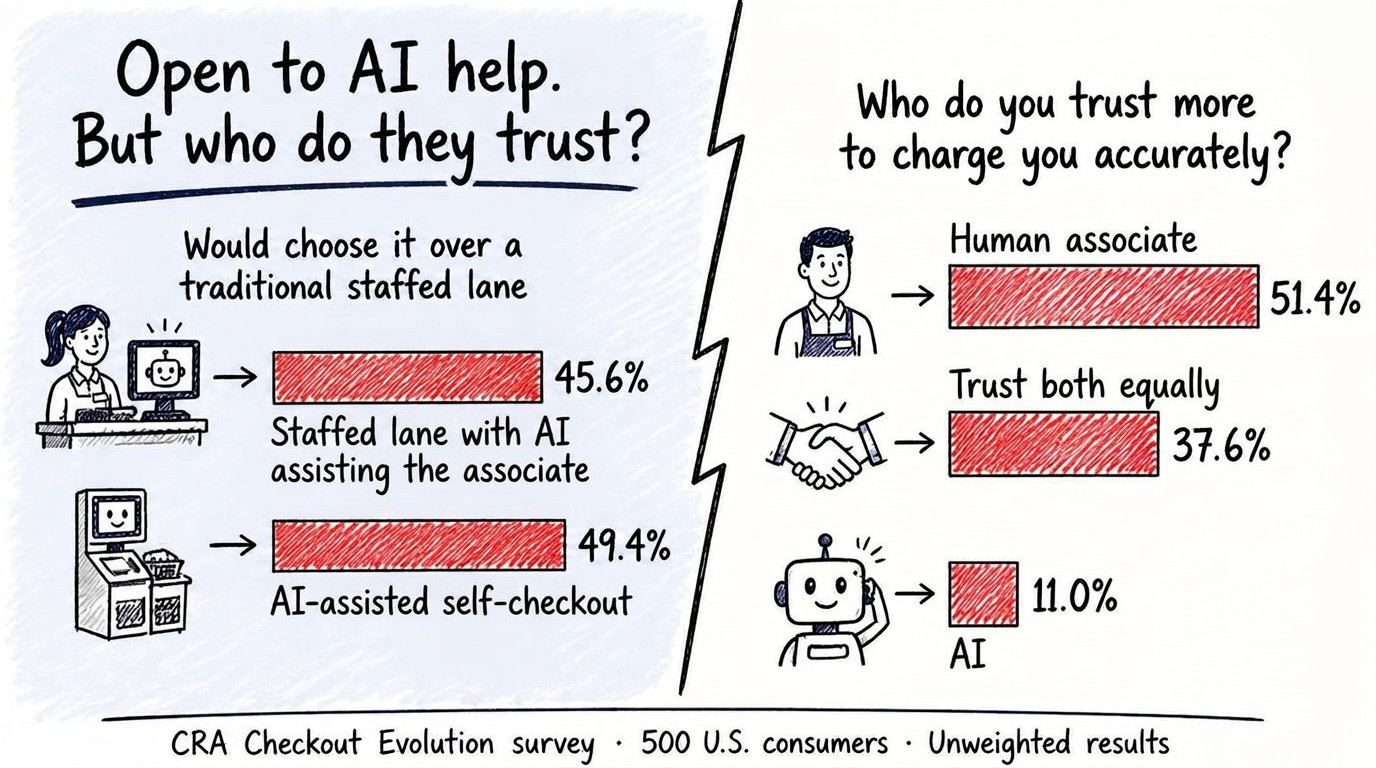
There's a contrast here. Shoppers seem open to technology that makes checkout more convenient, but that doesn't mean they're ready to hand over every decision.
Our survey didn't specifically ask about AI agents purchasing products on someone's behalf, so we can't draw that conclusion directly. Still, the findings raise questions about how much automation customers actually want.
And I suspect the answer depends on what someone's buying.
A few groceries? Let me get in and out quickly. A new television or a room full of furniture? I might want to spend more time talking with someone who knows what they're selling.
Retailers should give customers different ways to shop rather than assume everyone wants the same experience.
What We'll Be Looking for at NRF 2027
I expect there'll be some impressive AI demonstrations at Javits. But there's a difference between showing what technology can do and explaining how it works in a real retail environment.
For those interested in checkout and store operations, GK Software (Booth 6002) and Toshiba (Booth 3623) are worth visiting. Manhattan Associates (Booth 5438), which has been working with Adyen on integrated commerce and payments, is another company to consider.
Several NRF sessions connect directly to these questions.
Agentic Commerce: Lessons from Year One will bring together Adyen, SCHEELS, and VF Corporation to discuss early implementations. Fast-forward Agentic Commerce: When AI Agents Become the Buyer will examine what it takes to support AI-initiated purchases.
The Agentic Commerce Playbook: Lessons from Early Movers, featuring Stripe and Best Buy, should offer insight into implementation challenges. And Hype, Reality, or ROI? The Great Payment & Checkout Debate will examine which payment innovations deliver value.
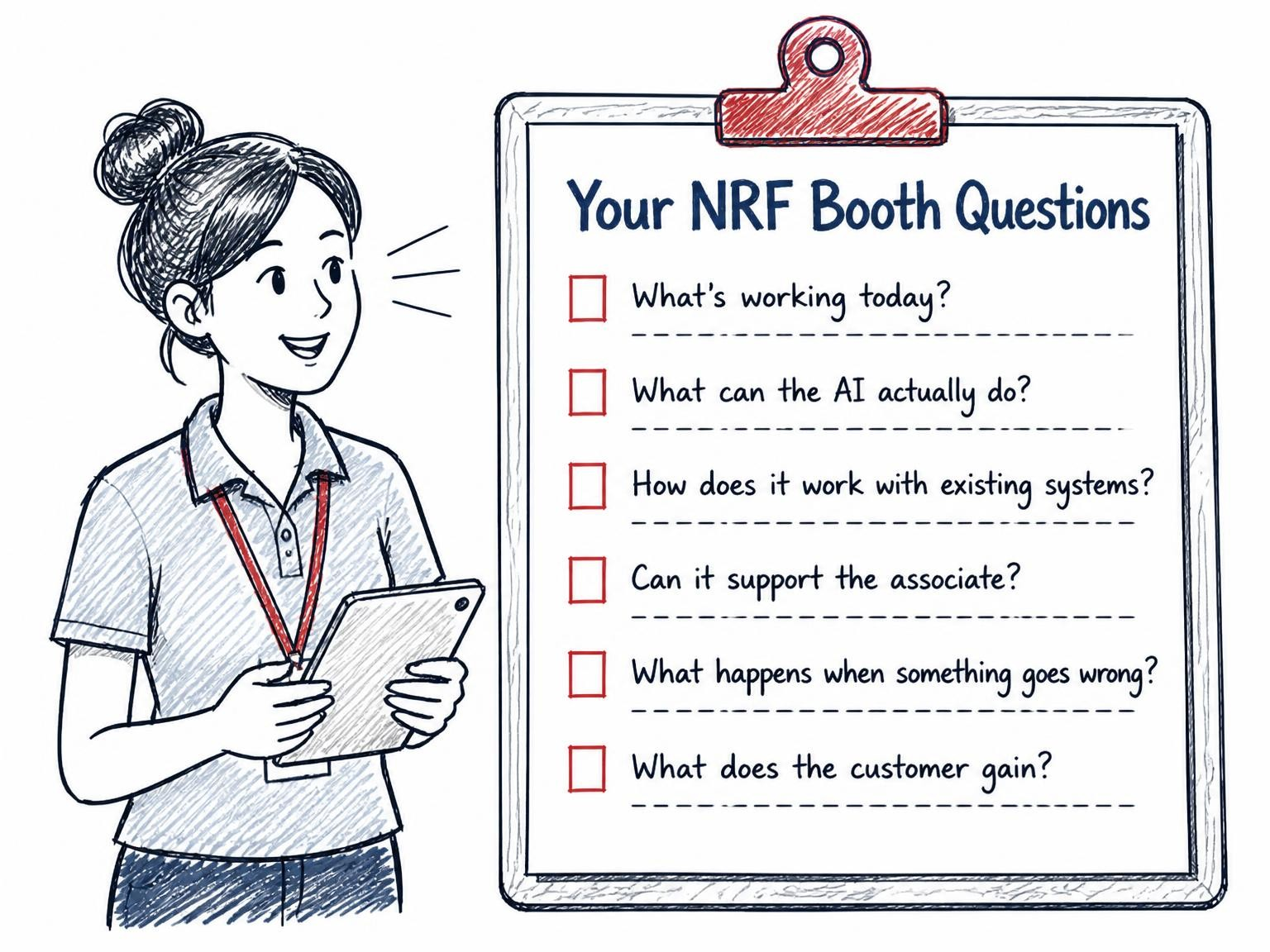
As we explore these solutions, here are a few questions I'd encourage retailers to ask:
- What's working today? Which retailers have deployed the technology, and what results are they seeing?
- What can the AI actually do? Can it complete transactions on a customer's behalf? What requires approval?
- How does it work with existing systems? Can it connect with the retailer's current technology without creating more complexity?
- Can it support the associate? Could a conversation started with an AI agent continue with someone in the store?
- What happens when something goes wrong? How are incorrect purchases or returns handled?
- What does the customer gain? Is shopping becoming easier, or is this just another place to sell products?
I'd also like to hear how vendors envision general-purpose AI agents working with retailer-branded assistants. Could an agent connect a customer with someone in the store or introduce them to a specialist who can help beyond the original purchase?
Those may not be the demonstrations everyone is showing at NRF, but they're conversations retailers should be having.
Looking Beyond the Transaction
AI will continue changing how customers shop. Some people will be comfortable letting an agent handle much of the purchasing process, while others will prefer to make decisions themselves or talk with an associate. Retailers should accommodate both.
An AI agent could help someone research a product before visiting a store, then make it easier for an associate to continue that conversation. It might even connect the customer with another business that offers something the original retailer doesn't.
We shouldn't limit our thinking to whether an AI agent can complete a transaction.
We should also be asking what it can help the customer and retailer accomplish together.
That's something worth exploring as we walk into Javits.
THE LENS
The short version for your next meeting.
The key points, what to try, and the question to ask your team. Free PDF. No form.
Get The Lens