

AI is getting better at recognizing when something goes wrong at checkout, or when some shenanigans are happening. Cameras can identify a possible missed scan, systems can spot unusual transaction behavior, and automated lanes can catch an exception before the customer even realizes there is one.
I don't think the fact that AI notices the problem is necessarily what makes customers uncomfortable. The more interesting question is what happens next.
Imagine you're at self-checkout with your basket and you scan your favorite box of cereal. Maybe the barcode was at a bad angle, or maybe you thought you heard the beep and dropped it in your bag. There's a lot going on at checkout. Your kid wants the toy or the gum by the register, an associate is helping someone two lanes over, there might be a screen playing ads above you, or you've got your headphones in. Things get missed. Nothing "evil" happened; something just didn't scan correctly.
One version of the experience tells you the barcode wasn't detected and asks you to rescan the item. You flip the box around, scan it again, and keep moving. In the other universe, the screen turns red, freezes the transaction, flashes the lane light, and tells you to wait for an associate.
Same basic exception. Very different experience.
Fix It vs. Freeze It
Our research reflects that difference. When AI simply flags a possible scan error, 61.0% of known customers (shoppers the store already recognizes, like loyalty members) say they're comfortable with it, compared with 53.4% when the customer is unknown. When AI instead holds a transaction for manual review based on purchase history, comfort falls to 44.6% among known customers and just 35.0% among unknown customers.

That makes me think the issue may be less about AI detecting something and more about who's in control. Mistakes happen, and most people get that. If the system says, essentially, "I saw something you might want to check," the customer still has a way forward. They can look at the item, review the receipt, rescan it, and move on.
When the system says, "You're done until someone clears you," the tone changes. Now the customer is standing there while the lane light flashes. An associate may have to come over, review the transaction, perhaps look at video, and clear the machine while other shoppers wait behind them.
A small technical exception has suddenly become a public event. That is where help me fix it starts to feel more like prove I didn't do something wrong.
Correct First, Escalate When Necessary
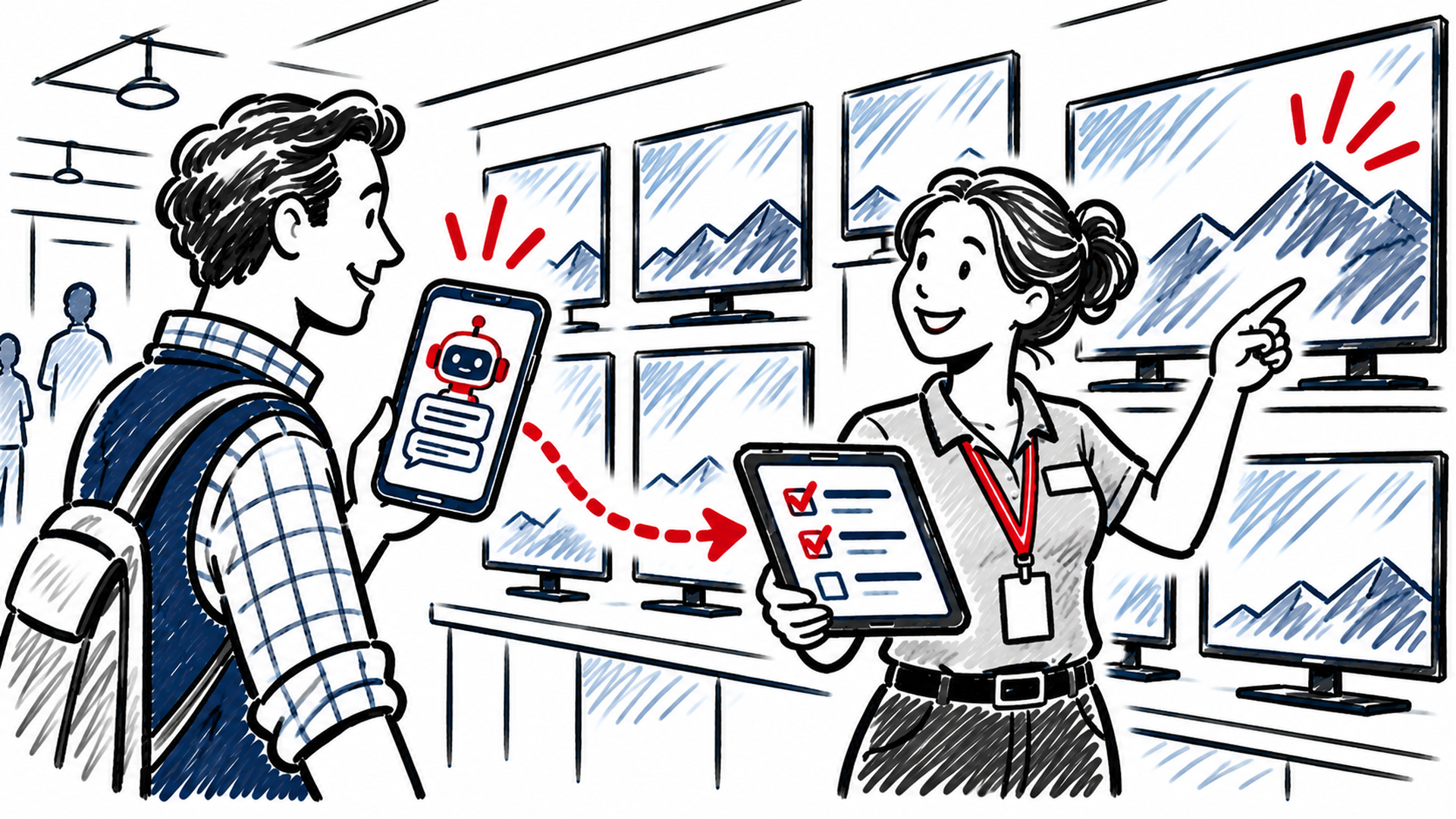
Morrisons, one of the largest U.K. supermarket chains, lets the customer fix it first. If the little monster living in the machine sees a missed scan, it replays the clip and asks you to try again. Miss it twice, and an associate comes over to help.
The customer doesn't have to pull the attendant whistle every time something happens. If every exception needs an employee, you might as well have the employee scan everything to save time.
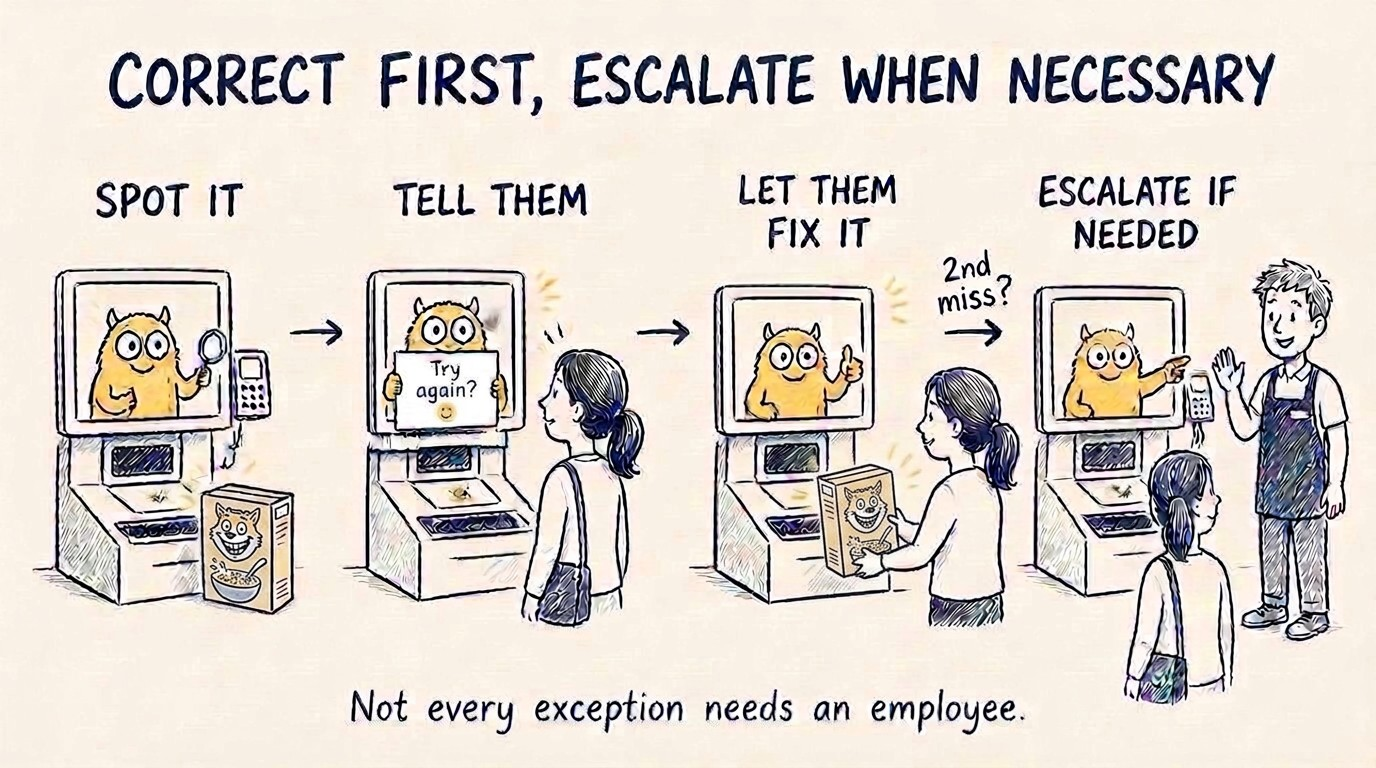
The flow is pretty simple: detect the issue, tell the customer what happened, give them a chance to correct it, and escalate when necessary. There is an operational benefit to that too, because every unnecessary intervention stops the customer and pulls an employee away from something else.
A false positive creates friction on both sides of the transaction.
And this matters because self-checkout already asks the customer to do some of the work. When we combine that with increasingly sophisticated loss-prevention technology, we have to be careful about the bargain we are creating. "Scan your own items while we closely watch you because we don't completely trust you" is not a great customer proposition.
What Happens When No One Is There?
The issue becomes even bigger when we move toward more autonomous checkout.
Our research found 49.0% of known customers comfortable with autonomous checkout when no human backup is available. Among unknown customers, that dropped to 41.4%. Shoppers ages 50–64 were the most uneasy: 50.5% uncomfortable when known, 57.2% when unknown.
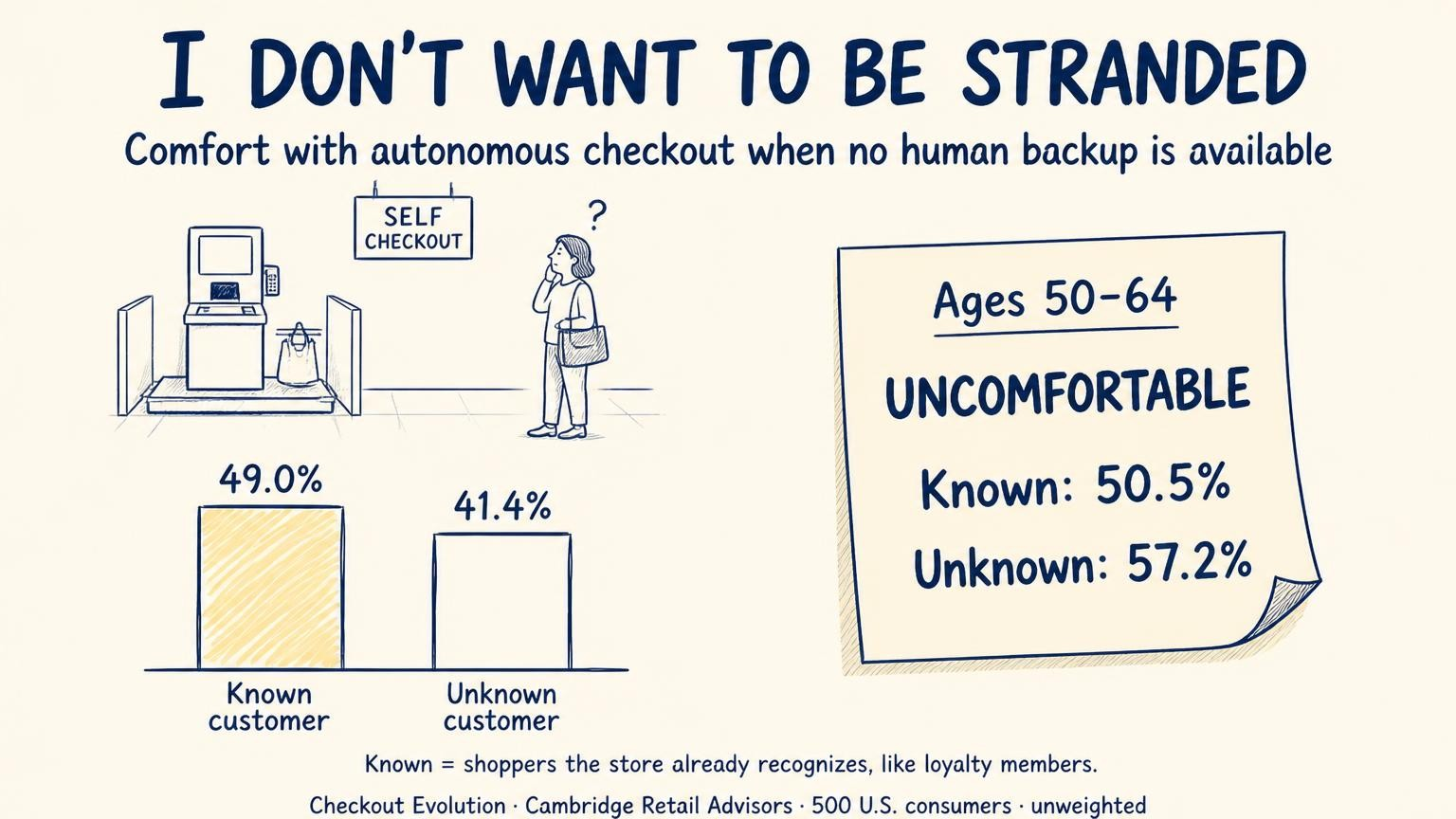
I don't read that simply as customers saying, "I want a cashier." I think many of them may really be saying, "I don't want to be stranded."
Automation is easy to admire when everything works. The item scans, the payment approves, the receipt arrives, and the customer leaves. But routine eventually stops being routine. A coupon doesn't work, produce won't scan, payment fails, an age restriction appears, or the customer simply has a question. That is when the human becomes valuable.
Human Support Is Part of the Automation
Dollar General is a good reminder. After struggling with shrink and operational challenges, the retailer pulled self-checkout from most of its stores. But removing the person doesn't remove shrink issues, payment problems, age checks, technical failures, or customer questions.
The work moves. It doesn't disappear.
That is why human support does not have to represent a failure of automation. The associate can be part of the automation architecture.
This is where staffing matters too. If a store is going to operate a large bank of self-checkouts, one person trying to monitor a dozen active transactions is not the same thing as meaningful human backup. We may need to think less about how many associates we can remove and more about how fast one of them can get to a customer who's stuck.
Rethinking What Success Looks Like
The promise of AI at checkout should not be that nothing will ever go wrong. That is unrealistic.
The better promise is that when something does go wrong, the customer still has a way forward.
Automate the routine. Preserve control at the moments that matter.
That's one side of the AI question: what happens when something goes wrong. The next one may be harder — what happens when nothing is wrong, but AI starts changing the deal itself?
THE LENS
The short version for your next meeting.
The key points, what to try, and the question to ask your team. Free PDF. No form.
Get The Lens