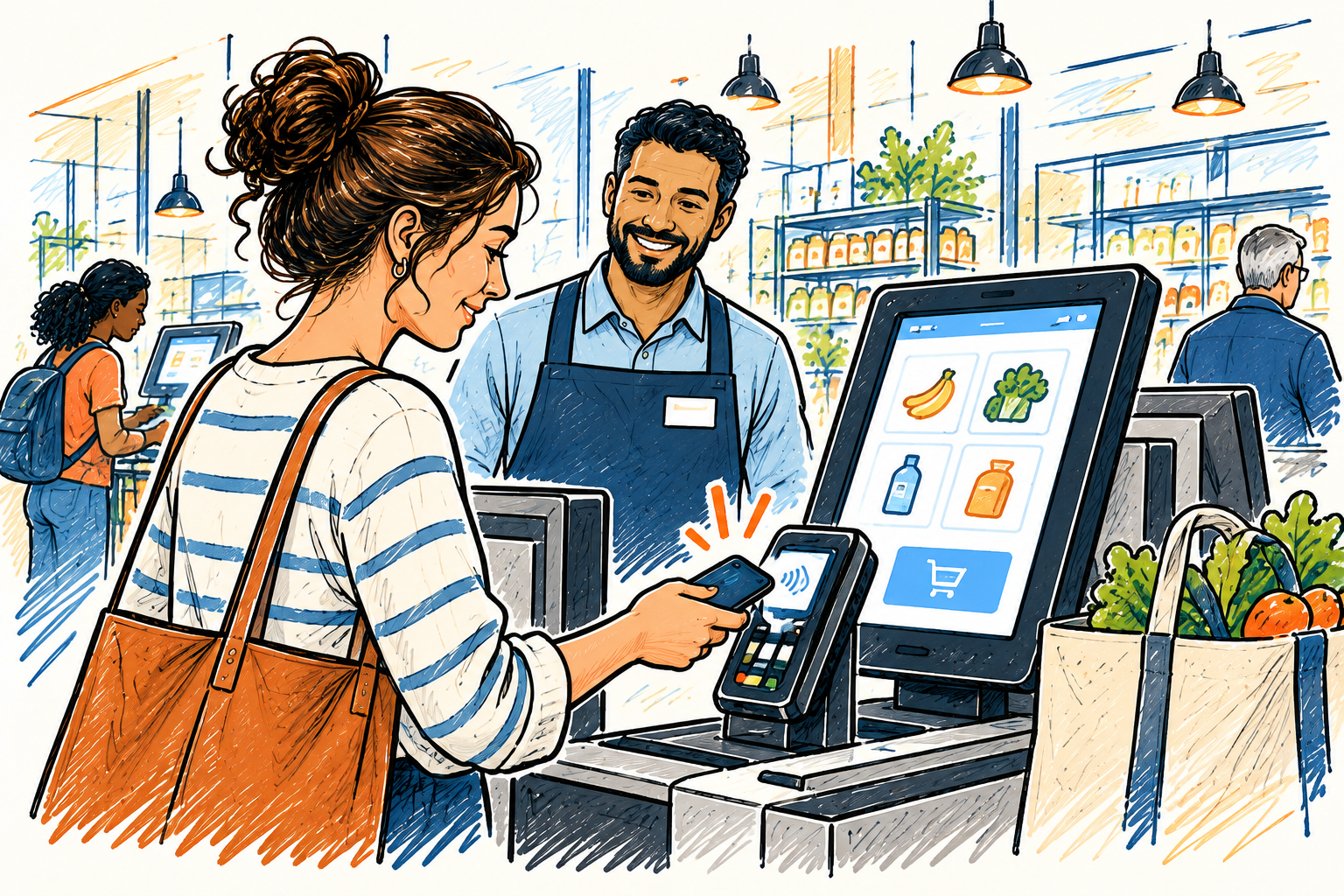


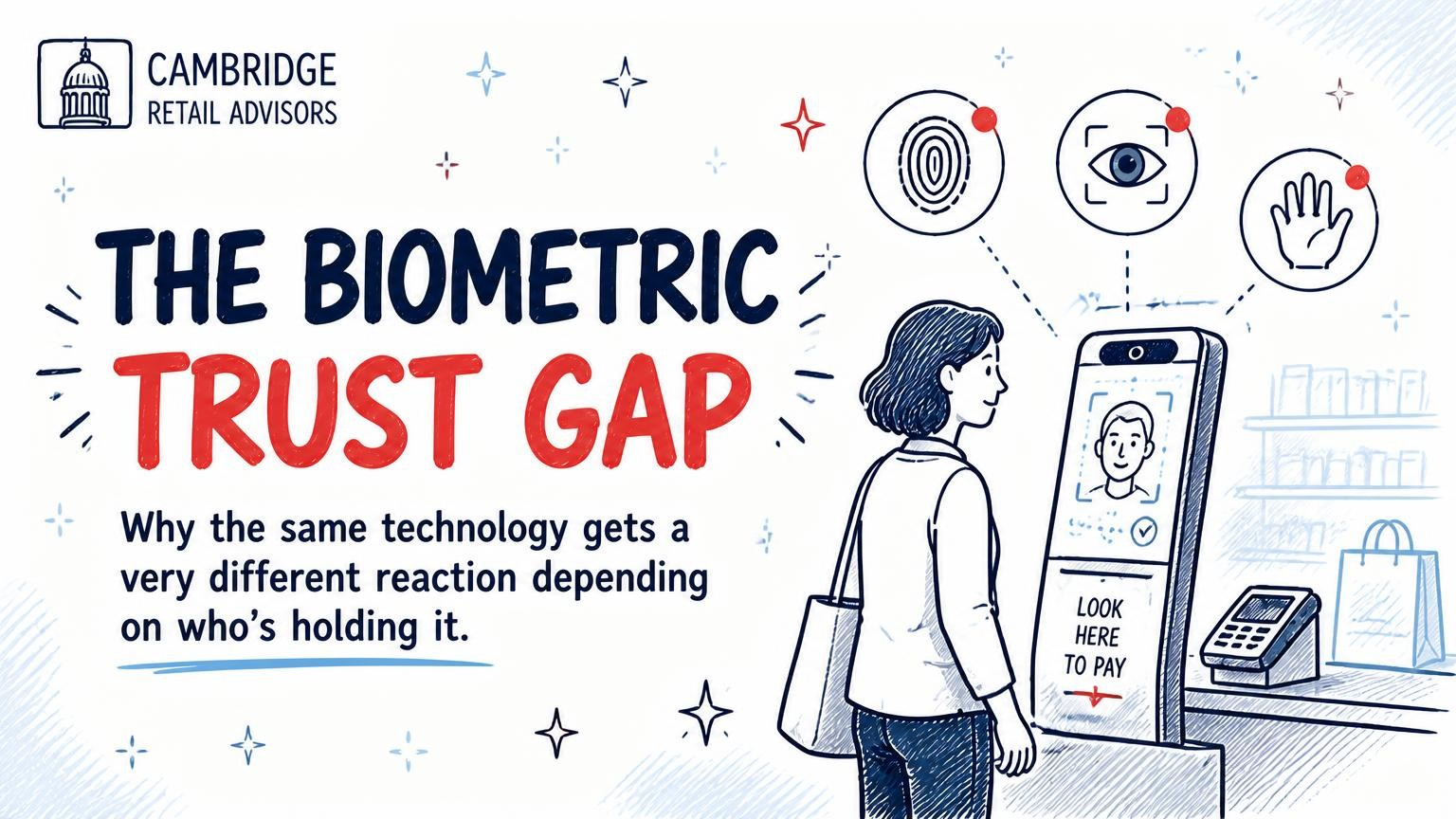
The exploration of biometrics in payments continues to move full steam ahead and is advancing as brands in retail, hospitality, and their partners work to validate and test various use cases to see where biometrics enhance the experience.
That could mean improving security, reducing friction at the point of purchase, simplifying identification, or making parts of the customer journey easier. At this point, we know the technology is viable.
The bigger question is where it actually makes sense.
As we at CRA look at our survey data, our experience, industry research, and the broader conversation around biometrics, what keeps standing out to us is that there are two key customer questions anyone looking to bring this into their brand experience needs to understand.
The first thing we want to understand is trust: are customers comfortable using biometrics as part of the experience?
The second thing we want to understand is whether payment alone creates enough value to make customers want to use it — something we’ll address separately in an upcoming article.
For the sake of this conversation, we are going to focus on trust, because even asking whether customers are “comfortable with biometrics” may be too broad. A customer may feel very differently about using biometrics for payment with one brand versus another, and that comfort may also change depending on the experience happening in that moment.
Someone at a sporting event or on a cruise may think about biometric identification differently than they would at a convenience store. The same can be true across hospitality brands, payment networks, and third-party technology providers.
Each situation brings a different level of familiarity, trust and expectation.
There could be any number of reasons behind those differences. Familiarity with the brand, the experience itself, what the biometric is being used for, and who ultimately sits behind that relationship could all play a role. The point is that biometric trust is unlikely to be one-size-fits-all.
Why Biometrics Deserve More Scrutiny
Part of what makes this conversation different is that biometrics are not just another preference, loyalty setting, or payment credential.
A password can be changed. A credit card can be replaced. A phone can be replaced.
Your face, palm, or fingerprint is different.
It is part of you.
That does not mean biometric systems are inherently unsafe. These systems can be designed in different ways, the information can be protected in different ways, and different models can determine who holds or processes it.
But most customers are not standing at a checkout thinking about biometric templates, encryption, or tokenization. They are thinking about something much simpler: who has my information, what are they doing with it, and what control do I have over it?
That is why biometrics deserve a different level of scrutiny.
The technology may be secure. The architecture may be sound. But if the customer does not understand the relationship, the trust problem is still there.
The Trust Gap Starts to Show
This is where the data gets interesting.
When a biometric payment is connected to an existing payment network — think Visa, Mastercard, or another card relationship the customer already knows — 30.6% of consumers said they were comfortable with that model, compared with 26.8% who were uncomfortable. That leaves 42.6% somewhere in the middle.
The picture shifts when that biometric relationship is established directly with a retail brand. Comfort drops to 27.8%, while discomfort rises to 37.4%, leaving another 34.8% somewhere in the middle.
That middle ground is still up for grabs.
Where the Trust Gap Widens by Generation

Ages 18–34
This is where we see the most openness. Among consumers ages 18 to 34, 45.7% were comfortable with a retailer-specific biometric model, while 25.7% were uncomfortable.
There is also an interesting twist: this group was actually slightly more comfortable with the retailer-specific model than with the card-network model, where comfort was 41.9%. So for younger shoppers, the overall card-network advantage we see across the full sample does not hold in quite the same way.
Ages 35–49
The picture starts to shift among consumers ages 35 to 49. Comfort with retailer-specific biometrics falls to 33.7%, while discomfort rises to 35.3%.
This group sits much closer to the middle of the trust conversation — not clearly rejecting biometrics, but not showing the same level of comfort as younger shoppers either.
Ages 50–64
The trust challenge becomes much clearer among consumers ages 50 to 64. Just 13.5% were comfortable with retailer-specific biometrics, while 45.2% were uncomfortable.
That is a very different starting point from the youngest group and reinforces why brands should be careful about treating biometric adoption as one customer conversation.
The age breakdown makes the larger point even clearer. There is opportunity here, particularly with younger customers, but comfort is not developing evenly across the market.
When Trust Starts Affecting Store Choice

The trust gap does not stop at stated comfort. It also starts to show up in whether biometric payment could influence where customers choose to shop.
When we asked about a biometric payment option connected to an existing card network — one the customer already knows and has a relationship with — 31.6% of consumers said it would make them more likely to choose that store, while 26.6% said it would make them less likely. The largest group, 41.8%, said it would have no impact either way.
That creates a net positive effect of 5 percentage points. The card-network model drew in more customers than it pushed away.
The retailer-specific model moved in the opposite direction. 28.2% said it would make them more likely to choose the store, while 36.8% said it would make them less likely — a net negative effect of 8.6 percentage points.
Put simply, more consumers said that model would push them away than draw them in.
One model is not suddenly a major traffic driver and the other is not a dealbreaker — the numbers are not that dramatic. What matters is that the direction changes depending on how the biometric relationship is structured.
A brand may see biometric payment as a way to improve speed, security, identification, or convenience, but the customer is evaluating more than the technology itself. They are also evaluating who is asking them to use it, who controls the relationship, and how comfortable they are with that arrangement.
Trust becomes part of the business case whether the brand planned for it or not.
What Does “Uncomfortable” Actually Mean?
When a customer says they are uncomfortable with biometric identification, what are they actually worried about?
Is it who owns the biometric data, where the information is stored, or whether it can be shared with someone else? Are they worried about whether it could be sold, whether they can delete it later, or whether it could be used to track them across locations?
It could also be something much simpler. The technology may still be unfamiliar enough that some customers do not really understand what is happening, what is being collected, or what they are agreeing to.
Those are very different concerns, and they require very different answers.
There is also the question of what happens to the information after it is collected. A customer may be comfortable with a camera helping recognize an item or simplify checkout, but feel very differently if that same technology is being used to profile behavior, create marketing segments, or generate insights that are sold or shared with another company.
That is really the question underneath all of this: what did I actually agree to? What is being captured? Who holds it? What is it being used for? Can it be shared or sold? Can I opt out? Can I remove it later?
And if I give you access to something this personal, what am I getting in return?
Both the value question and the question of secondary use — how this data may be shared or monetized after collection — deserve their own conversations, and we’ll come back to them separately.
A brand is not going to eliminate every hesitation with a privacy policy. But that does not mean the answer has to be complicated either.
If customers are standing in a queue, approaching a biometric-enabled checkout, or deciding whether to enroll, that is an opportunity to explain what is happening in plain language. A short video, a simple screen, or a few clear answers to the questions customers are already asking could go a long way.
If we want customers to trust the experience, we have to help them understand the experience.
That is a start. But we still need to understand more specifically what customers mean when they say they are uncomfortable.
There may also be another variable we have not tested yet: context. A customer may view biometric identification differently in a convenience store than they would in a hotel, stadium, grocery store, or department store.
That is something we want to explore in the next wave of research.
Familiar Relationships May Have an Advantage
Earlier, we saw that consumers were more comfortable with the card-network biometric model than with the brand-specific model overall.
One possible explanation is familiarity.
But familiarity may mean more than simply recognizing the name on the card. Customers often build trust through the relationship over time — through the products they use, the benefits they receive, the experiences connected to the brand, and the ways that relationship has made things easier for them.
Think about a customer who has used the same card network or financial brand for years. That relationship may extend into travel benefits, lounges, special events, loyalty experiences, or other moments where the brand has already earned some level of trust.
That may make adding biometric verification feel different from being asked to create a completely new biometric relationship somewhere else.
We know there is a gap. We do not yet know exactly why that gap exists.
That is something we want to explore more deeply in the next wave of research — whether trust is driven by familiarity alone, by the value built through the relationship, or by the broader experiences customers already associate with that brand.
The Question for Brands
The strategic question may not be whether customers will use biometrics.
It may be who they will trust to make biometrics work on their behalf.
Brands do not necessarily have to own every part of the biometric relationship to create a better experience. In some cases, a trusted provider may authenticate the customer and pass only what the brand needs to complete the interaction. In others, customers may be perfectly comfortable with the brand owning that relationship directly if the experience is familiar, the controls are clear, and they understand what is happening.
What matters is not assuming that every biometric model feels the same to the customer.
We have already seen differences in overall comfort, differences across age groups, and differences in how the model can influence store choice. We also know there is still a meaningful group of customers whose opinions are not firmly set.
That creates an opportunity, but it also creates responsibility.
If brands want customers to adopt these experiences, trust cannot be something that gets addressed after the technology decision has already been made. It has to be part of how the experience is designed from the beginning.
So How Are You Handling Trust?
For brands, payment providers, and technology partners, the conversation is becoming less about whether biometric payments are technically possible and more about how the trust relationship is going to work.
Who owns that relationship? What does the customer understand about it? What control do they have? How are you explaining the experience before asking someone to enroll?
And perhaps most importantly, are you treating trust as something the customer simply has to give you — or something you have to earn?
The technology is ready. But trust isn’t something a brand can install. It has to be earned through the experience.
How is your organization approaching biometric trust today? What are you hearing from customers, and where are you seeing the biggest hesitation?
THE LENS
The three-page version for your next meeting.
The key numbers, three things to try, and the question to ask your team. Free PDF. No form.
Get The Lens