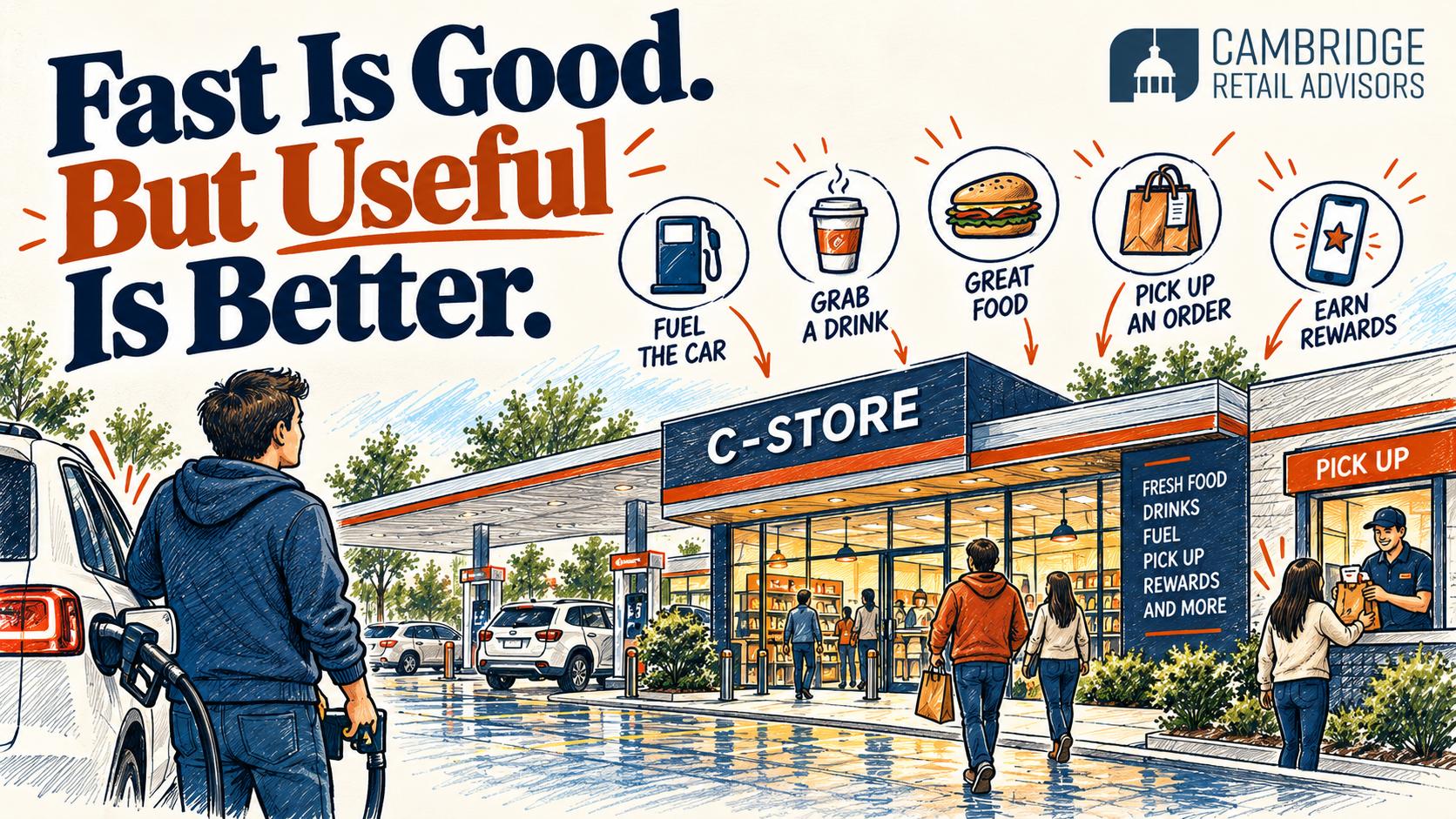


Sooner or later, your customer’s car, phone or another digital touchpoint is going to help them decide where they stop for fuel, grab a coffee, pick up lunch or get a quick meal.
You can already see the beginnings of this in tools people use every day. Google Maps helps drivers find stops along their routes, compare fuel prices and explore nearby food options. AI assistants like Gemini are making it easier to ask questions and compare choices without searching through multiple apps. As these capabilities become more connected, they could go beyond helping customers find a location to recommending specific offers, recognizing preferences and helping place an order before they arrive.
This evolution comes at an interesting time for convenience retailers. At the 2026 NACS Show in Las Vegas, Chris Rapanick, managing director of NACS Research, shared some troubling numbers. In-store transactions declined 4.5% during the first half of 2026 compared with the same period last year, representing more than 1,100 fewer transactions per store, on average. His concern went beyond the decline. Customers were increasingly stopping for fuel without even considering going inside.
That raises an interesting question. While many retailers are looking at AI primarily as a way to improve efficiency, I see another opportunity, and I’m sure I’m not alone. Could AI help us create more personalized experiences and give customers a compelling reason to come inside the store?
With this potential in mind, CRA included several questions in our current Customer Pulse research to better understand how consumers feel about AI-assisted shopping. We asked 500 U.S. convenience store shoppers how comfortable they would be letting their car or an AI assistant handle six different activities during a trip. The results suggest that customers are comfortable getting help with their decisions, but considerably less comfortable giving up control over the final purchase. That creates a challenge for retailers: how do we build enough trust for customers to take the next step? And what controls need to be in place to make them comfortable doing so?
Start by building trust with the easy stuff
The easiest place to start is where customers are already comfortable. 79.6% are comfortable letting AI find and show them the best available deal, while 66% are comfortable letting it recommend where to stop based on route, fuel price, food and rewards.
For convenience retailers, that means going beyond standard promotions. AI could help customers discover personalized offers based on their preferences, regular purchases and loyalty benefits. Maybe it’s a coffee promotion, a buy-one-get-one food offer or a fuel discount that makes a particular stop more worthwhile. It could also compare nearby locations, bringing together fuel prices, food options and available rewards without customers having to search through several apps.
These interactions could happen through a phone, retailer app, website or AI assistant. Walmart’s move to enable shopping through ChatGPT shows how these experiences are beginning to extend beyond retailers’ own digital channels.
The important part is delivering on the promise. When recommendations are relevant, offers are accurate and savings actually appear at checkout, customers have a reason to use the service again. That’s how retailers can start building trust before asking customers to give AI more purchasing responsibility.
Ordering with customer control
Once customers are comfortable getting recommendations, the next step is helping them place orders. 66.2% are comfortable letting AI place an order after they approve it, while 58% would let it assemble an order from things they regularly buy for them to review first. Another 56.1% would allow AI to reorder familiar items within limits they’ve already established.

DoorDash is already moving in this direction with its AI text assistant. Customers can send a message like “order my usual,” and the assistant puts together a suggested cart. Casey’s has taken a different approach, using SoundHound’s AI phone-ordering agents at approximately 2,600 locations. Customers can still call to order pizza or other prepared food, but an AI agent handles the conversation and takes the order.
Both examples show how AI can become part of familiar ordering experiences without requiring customers to completely change their habits. The next step is making it easy to review an order, confirm the details and make corrections when needed. Customers get the convenience of AI assistance while maintaining control over what they’re purchasing.
Giving AI more control takes trust
The bigger challenge comes when AI moves from helping customers place orders to making purchase or ordering decisions for them. While 56.1% are comfortable allowing an AI agent to reorder familiar items within limits they’ve established, that drops to 39.5% when AI can purchase without asking again. Another 44.3% are very uncomfortable with that level of independence.
The controls customers want based on our data help shed some light on that hesitation. 50.8% want to approve every purchase, 38.5% want an easy way to cancel or correct an order, and 29.5% want spending limits. Another 29.1% want an immediate notification after every purchase, while 21.1% want AI restricted to brands they’ve approved. And 20.7% wouldn’t allow AI to make purchases for them at all.
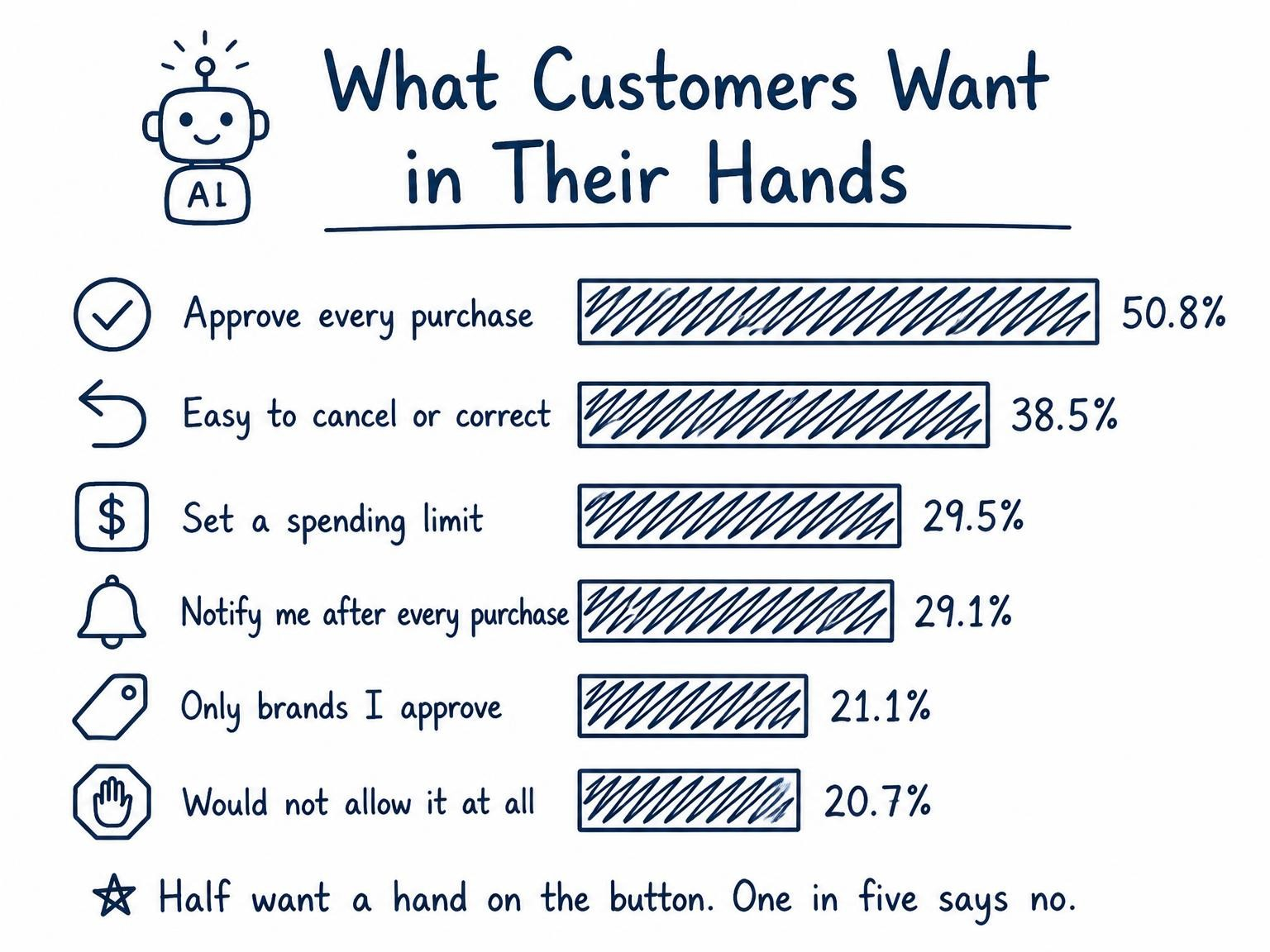
These controls aren’t necessarily barriers to adopting AI. They’re ways retailers can help customers feel more comfortable using it. The distinction between reordering within established limits and purchasing without asking again also suggests that customers value having a say in how much authority they delegate, even if those two questions measure slightly different activities.
What I’d do with this
I’d start with the interactions customers are already willing to try. Make stores easy to discover and compare, with accurate fuel prices, food offerings, promotions and loyalty benefits. Give customers personalized recommendations that offer real value rather than simply presenting another advertisement.
As ordering capabilities expand, keep the experience simple. Show customers exactly what’s in the order, what they’ll pay and how to make changes. Let them set purchasing limits and decide when they want to approve transactions.
And don’t overlook the operational side. A personalized food recommendation doesn’t mean much if the item isn’t available. An AI-assisted order creates frustration if the kitchen never receives it or the customer arrives before it’s ready. The technology may change how customers order, but the store still has to deliver.
Our research suggests customers are ready for those first steps, even if they’re not ready to surrender the final purchasing decision.
The first thing customers hand over won’t be the wallet. It will be the research. The stores that make themselves easy to discover, easy to buy from and worth returning to will be in a better position when AI starts influencing more of those decisions.
THE LENS
The three-page version for your next meeting.
The key numbers, three things to try, and the question to ask your team. Free PDF. No form.
Get The Lens