

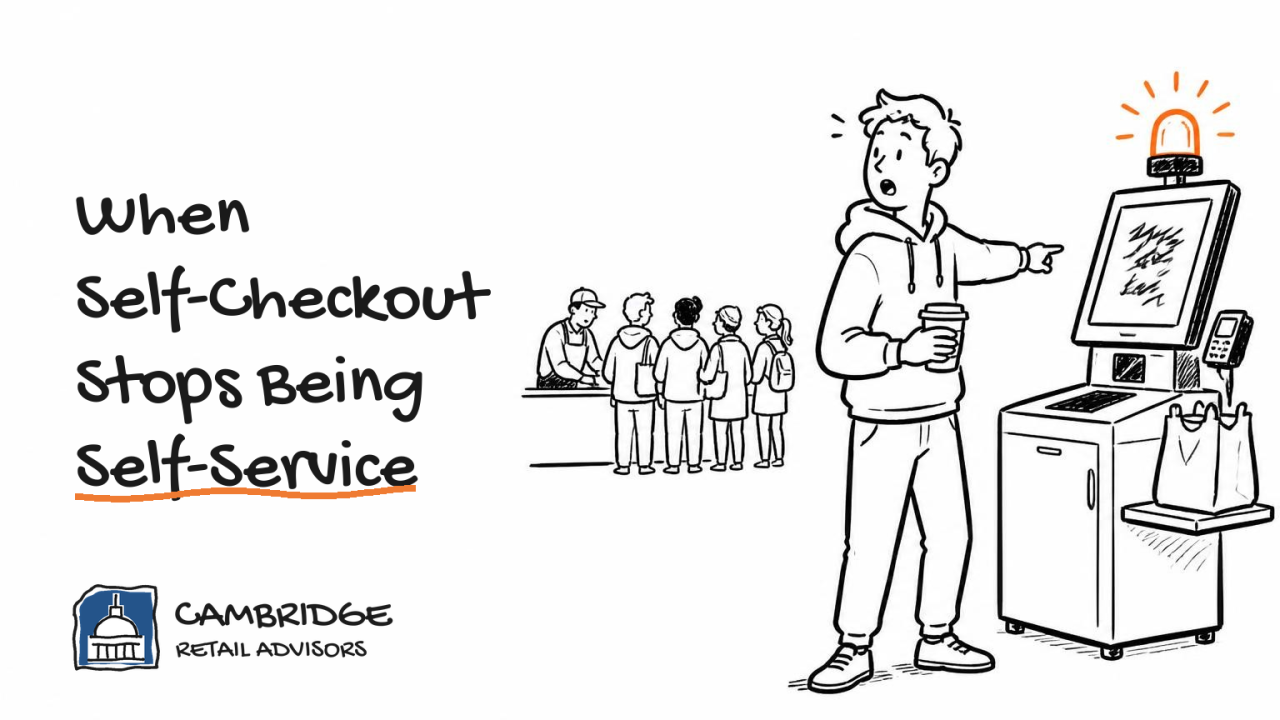
Self-checkout can remove routine transactions from the counter. But every exception that requires an associate puts some of that labor right back into checkout.
Self-checkout makes a lot of sense in convenience stores. Grab a coffee. Pick up a snack or prepared food. Scan a few items. Pay and get back on the road.
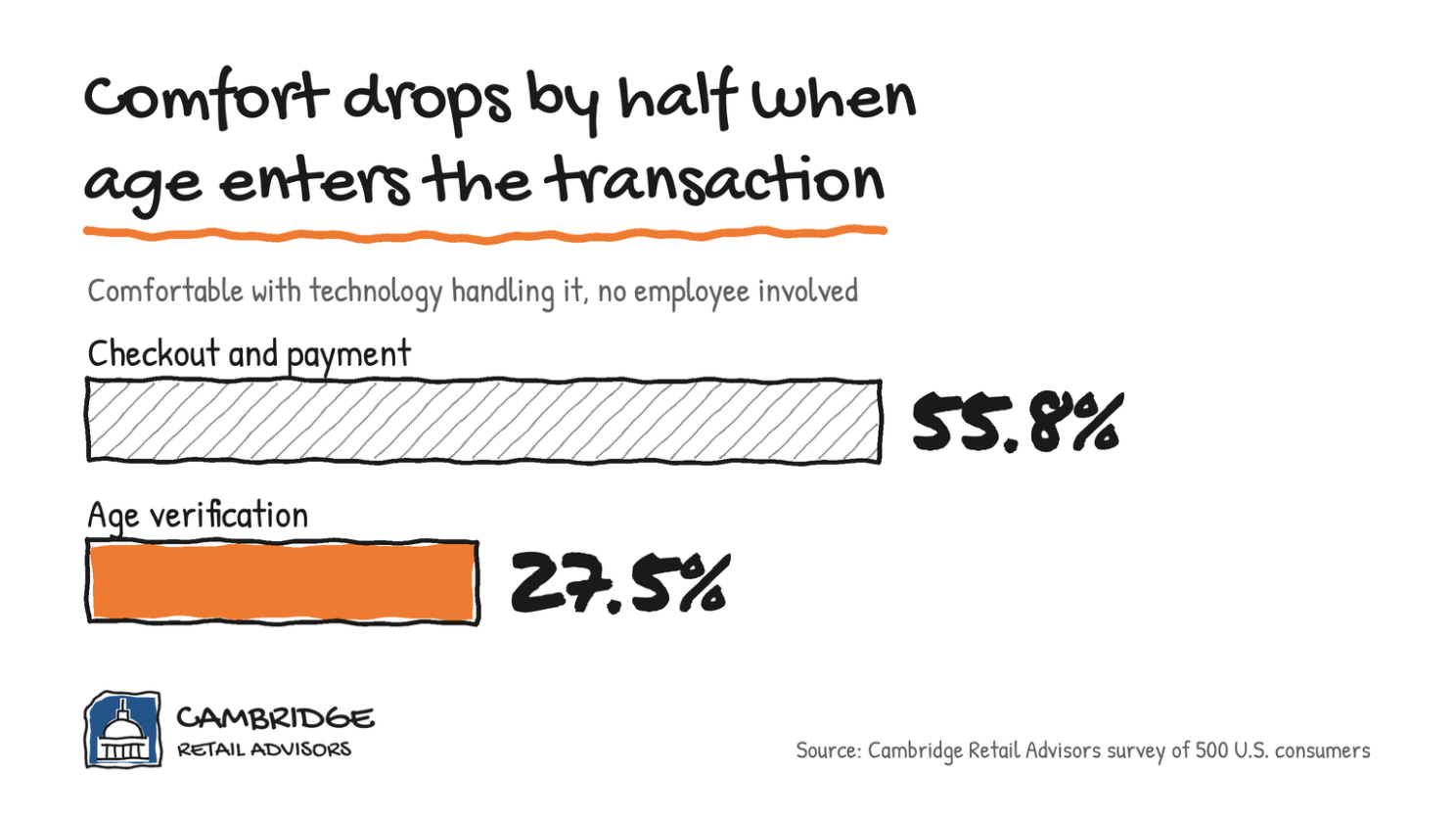
For much of the convenience-store trip, there’s no reason an employee needs to be involved in every transaction. Our latest Cambridge Retail Advisors survey of 500 U.S. consumers supports that: 55.8% said they were comfortable having technology handle checkout and payment without an employee involved.
The challenge starts when the transaction stops being routine.
When the Transaction Needs Something More
Think about what can happen in an otherwise simple c-store trip. Someone grabs a drink and a bag of chips, but also wants a pack of cigarettes from behind the counter. Someone buying alcohol needs an age check. Another customer hits an error at self-checkout and can’t move forward. A lottery customer is waiting at the counter at the same time.
Those aren’t unusual edge cases in a convenience store. They’re part of the business.
Age verification is a good example of where the limits of self-service show up in our research. Only 27.5% of consumers said they were comfortable having technology handle age verification without an employee involved. When we asked how they would prefer to prove their age, 43.9% chose showing a physical ID to an employee, while 21.6% preferred scanning the ID themselves. Digital driver’s licenses, pre-verified app passes, camera-based age estimation, and biometrics all ranked lower.
I don’t think biometrics solve this anytime soon. The technology is moving faster than customer comfort. That can change, especially as people use digital identity in more places, but today a significant portion of customers still wants a person involved when age enters the transaction.
And that means a trip that starts as self-service can turn into an assisted transaction quickly.
Customers Will Help — If We Help Them
The recovery data gets closer to the operating problem. When self-service detects a problem, 39.1% said an employee should be called over immediately, while another 10.3% wanted the purchase moved to a staffed checkout. But 31.0% wanted the system to show what went wrong and how to fix it, and 16.1% preferred trying to fix the issue themselves.
So eight in ten either want a person involved or want the technology to actively help them recover. Almost a third are willing to keep going if the machine gives them enough information to correct the problem.

That’s encouraging. Not every flashing light has to turn into an employee intervention.
The customer needs to know what happened, what they can do about it, and, when they can’t fix it themselves, that someone is coming.
The Exception Tax
Grocery has an advantage here. Walk into a lot of grocery stores and there’s someone watching a bank of self-checkouts. Clearing those exceptions is the job at that moment.
A c-store is different. The traditional c-store counter has become an everything point. The person called to the self-checkout may also be running the register, getting cigarettes from behind the counter, handling a lottery customer, dealing with fuel customers, stocking or helping with foodservice. There may only be one or two people covering all of it.

So when self-checkout needs help, the cost isn’t only the few seconds it takes to clear the screen. Something else can stop too.
That’s the exception tax.
Self-checkout removes employee involvement from a lot of routine transactions. An exception gives part of that labor back, except now it comes back as an interruption. The associate changes tasks, clears the problem, then tries to get back to whatever they were doing before.
One intervention doesn’t sound like much. Across a busy hour, a full day, and a large store network, I’d want to know what those interruptions add up to.
Our consumer survey didn’t measure exception frequency, intervention time, or labor cost, so I’m not going to manufacture a dollar figure.
But operators can.
How many self-service transactions need an employee? How long does each intervention take? And what was that employee doing when the interruption happened? That might tell you more about the real labor impact of self-checkout than utilization alone.
We’ve Already Changed Other Choke Points
Convenience stores have done some of this with foodservice. Instead of making every food order another conversation at the register, customers can order at a kiosk or through an app, and the order moves into the preparation flow. Employees can focus on making the food rather than taking every order across the counter.
There’s a similar lesson in the drive-through. Chick-fil-A has moved team members with tablets farther into the drive-through line to reduce wait times rather than relying only on the traditional speaker-box sequence. Its Mobile Thru model separates another part of the journey: customers order ahead in the app, enter a dedicated lane, scan a QR code to check in, and receive their order from a team member.
People are still there. They’re just entering the transaction differently.
I think that’s closer to the question c-stores should be wrestling with. If an associate is still needed for some transactions, where does that handoff make the most sense?
Where Does Self-Service Go Next?
I’d start with the two areas the research points toward. First, let customers solve more of the problems they’re already willing to solve. If the machine knows what happened, tell them. A generic “wait for assistance” message turns something the customer might have fixed into another interruption.
Second, move verification earlier when it makes sense. Age verification is already heading in that direction. TruAge, for example, verifies age rather than identity using an encrypted, single-use token, and NACS says the approach requires no new checkout hardware.
That won’t fit every retailer or every transaction. And there are still plenty of cases where a person belongs in the experience.
The next step in convenience-store self-service isn’t just adding more automation. It’s reducing the exception tax: understanding which moments customers can handle themselves, which still benefit from a person, and making that handoff less disruptive.
THE LENS
The three-page version for your next meeting.
The key numbers, three things to try, and the question to ask your team. Free PDF. No form.
Get The Lens